It is spring in the Southern Hemisphere, and a gentle spring breeze is blowing. At the Presidential Palace in Pretoria, South Africa, a building that has weathered a century of vicissitudes, President Xi Jinping and President Ramaphosa stood side by side, looking down over the thriving city.
Reprinted from People’s Daily
Original title: When the Great Way Prevails, the World Is for All
— A Record of Several Historic Moments from President Xi Jinping’s Visit to South Africa
It is spring in the Southern Hemisphere, and a gentle spring breeze is blowing. At the Presidential Palace in Pretoria, South Africa, a building that has weathered a century of vicissitudes, President Xi Jinping and President Ramaphosa stood side by side, looking down over the thriving city.
“What a sweeping view! I have no fear of floating clouds obscuring my vision, for I stand upon the highest peak.” President Xi’s reflection seemed a vivid portrayal of this visit.
From August 21 to 24, in South Africa.
Three sets of keywords: China-South Africa, BRICS, and China-Africa. President Xi attended the 15th BRICS Summit and paid a state visit to South Africa. Based in South Africa and BRICS, he set his sights on Africa and the world.
25 years of working hand in hand: the “Golden Era”
On the evening of August 21, after a flight of more than ten thousand li, President Xi’s special plane landed in Johannesburg, South Africa.
It was already late at night. In the chilly spring breeze, President Ramaphosa, who had come specially, waited at the foot of the boarding stairs.
South Africa holds the BRICS chairmanship this year. This high-level courtesy of coming in person to the airport to welcome the guest, breaking with diplomatic convention, appeared all the more heartfelt amid the host’s tight schedule.
At the foot of the stairs, the two hands clasped tightly together.
President Ramaphosa had said earlier that if President Xi came, then however busy he was, a state visit would be arranged. It became the only state visit South Africa arranged during this BRICS summit.
The next day, at the Presidential Palace in central Pretoria, President Ramaphosa came out to welcome him once again. After the grand welcome ceremony, his warmth won over the room as soon as the talks began:
“This is a historic moment, a moment to express our gratitude, and a moment for us to celebrate.”
“President Xi, welcome — we welcome you with open arms. We are your true friends, and we know that you are our true friend. It is a real honour to receive you on your visit to South Africa.”
Five years ago, the two leaders met for the first time as heads of state — and that was also the first state visit President Ramaphosa received after taking office.
“I can recall every one of our conversations — every phone call, every meeting at gatherings elsewhere in the world.” Looking back, President Ramaphosa was moved.
Their last phone call was in June this year, when South Africa was encountering difficulties in hosting the summit in person. President Xi’s encouragement was like rain on parched fields: “China supports South Africa, as BRICS chair, in hosting all BRICS cooperation events this year successfully.”
Shoulder to shoulder in difficult times and at critical junctures. The signing ceremony witnessed by the two heads of state yielded rich results, and the list of outcomes that followed was equally impressive. Manned spaceflight, the digital economy, the blue economy, health care and education, special economic zones… reaching into space and across the seas — cooperation for mutual benefit.
Take power supply.
Power shortages are a “pain of development” for South Africa. On this visit, China-South Africa cooperation on emergency power, on investment in new-energy power and on power grid upgrading and renovation… each item addressed South Africa’s most pressing needs.
Take poverty reduction.
President Ramaphosa was eager to learn from China’s experience: “China has gone from being a country that was invaded and desperately poor to achieving the historic accomplishments of today; no one can compare.” President Xi responded positively, saying that China is ready to strengthen exchanges of experience with South Africa and to help it carry out demonstration village projects for poverty reduction.
Take investment.
President Ramaphosa said that in the next five years South Africa hopes to attract more than 100 billion US dollars in additional foreign investment. President Xi gave clear support: “China will expand imports of South African products and encourage more Chinese enterprises to invest and do business in South Africa.”
During the talks, President Ramaphosa brought up Zheng He’s voyages to the Western Seas. On the ancient Silk Road, with its “sails unfurled high and ships racing day and night,” China and Africa exchanged goods and came to know one another. Across a thousand years, and accompanying the Chinese nation on its journey of rejuvenation, the sleeping ancient Silk Road has been awakened and history has turned a new page. After the Belt and Road Initiative was proposed, South Africa became the first African country to join it. The Letter of Intent between China and South Africa on Agreeing to Deepen Belt and Road Cooperation signed on this visit paints an even grander picture of the future.
And how could China not be grateful to South Africa? On issues concerning core interests and major concerns, South Africa has always stood firmly with China. Having risen up in struggle against apartheid, South Africa knows well the value of independence. After China put forward its position on the political settlement of the Ukraine crisis, South Africa was among the first to give positive support. Subsequently, South Africa and other countries formed a peace mission to mediate, and the proposals they put forward were highly consistent with China’s position.
In his talks with President Ramaphosa, President Xi could not help but observe: “China-South Africa relations have gone beyond the bilateral scope and acquired global strategic influence; they have also shown the world the strength that cooperation among developing countries and emerging market countries can bring.”
For more than half a century, the friendship of mutual support between the two major parties, the African National Congress and the Communist Party of China, has forged the essential character of China-South Africa relations: “comrades plus brothers.”
Twenty-five years ago, China and South Africa established diplomatic relations. From a partnership to a strategic partnership and then to a comprehensive strategic partnership, President Xi commented: “We have entered a ‘golden era,’ with bright prospects and a promising future.”
Ten years ago, on his first overseas visit after becoming President, he set foot on the African continent. Those radiant smiles and bright eyes, those warm embraces and heartfelt words, are still fresh in memory.
“Over the past 10 years, I have witnessed the vigorous growth of China-South Africa relations. The reason these relations are so good and this friendship so deep lies in the fact that our two countries and two parties have shared weal and woe on our respective development paths and have formed a profound friendship.” On this visit, President Xi proposed the “four partnerships”: “strategic partners with high mutual trust,” “development partners progressing together,” “friendly partners who understand and feel close to each other,” and “global partners upholding justice,” and, together with President Ramaphosa, drew up a new blueprint for China-South Africa relations.
The two heads of state agreed to work hand in hand to take the China-South Africa comprehensive strategic partnership to new levels and to build a high-level China-South Africa community with a shared future.
Some media described the visit as “a beacon of hope for future cooperation and understanding.” A South African diplomatic observer wrote that President Xi’s leadership has always been a bridge in relations between Beijing and Pretoria, and that since taking office this dynamic leader has creatively developed and consolidated China’s friendly relations with Africa.
In the afternoon, the inner courtyard of the Presidential Palace was bathed in sunshine and bright with flowers. President Ramaphosa took up the Order of South Africa and solemnly bestowed it on President Xi. “You are awarded the highest honour for those who have made outstanding contributions to South Africa.” “The people of South Africa salute you.”
President Xi responded: “I wish to reiterate that no matter how the international situation changes, China’s determination to deepen friendly cooperation with South Africa will not change.”
10 years of deep cultivation: “a shared future”
Who are true friends, and who are true partners?
In Johannesburg, the answer could be heard clearly from the conference hall of the Chinese delegation’s residence.
Here, on the evening of the 24th local time, President Xi and President Ramaphosa co-chaired the China-Africa Leaders’ Dialogue.
In those days, the “BRICS Plus” events held on the African continent brought together representatives of almost all African countries. Seizing the occasion, the Chinese and African heads of state held their first collective face-to-face meeting since the COVID-19 pandemic.
Friends meeting again felt especially close. The guests arrived in an “8+2+1” line-up. Eight: representatives of Africa’s eight sub-regions. Two: Comoros, current AU chair, and Senegal, co-chair of FOCAC on the African side. One: the African Union Commission.
Why was the theme of this dialogue set as “Promoting Africa’s Integration and Building a High-Level China-Africa Community with a Shared Future”?
Going alone is fast; going together goes far. Africa has always valued the collective and sought unity. Recently a call has rung out especially loud across the continent: to use the formal launch of the African Continental Free Trade Area to advance industrialization and integration, and to look to its most important partner, China, for support.
President Xi once used the saying “plant melons and you get melons, sow beans and you get beans” to describe the inner logic of diplomatic relations, and it fits perfectly here. Why China? At the dialogue, President Ramaphosa voiced the shared sentiment of Africa:
“China has come to Africa’s aid when Africa needed it most; China is a partner that can see the needs of the African continent. China has never been a colonial power. We have benefited greatly from Africa-China cooperation; this relationship is mutually enabling and mutually beneficial.”
Musa Al-Koni, Deputy Head of Libya’s Presidential Council, was the first to enter the hall: “The direction of China’s efforts in Africa is exactly what the African people think about and hope for. The African people look to China, and every African country wants to cooperate with Chinese friends.”
And for China, is Africa not a solid partner with enormous potential? A continent of 1.4 billion people, Africa opens its arms to welcome China amid a shifting international landscape and under the headwinds of “decoupling and breaking chains.”
With the new development pattern of “dual circulation” and high-level opening up advancing in depth, China’s handshake with the African continent is undoubtedly an act of win-win cooperation.
“China and Africa have always been a community with a shared future.” Ten years ago, on his visit to Africa, President Xi first put forward the principle of sincerity, real results, amity and good faith in China’s policy toward Africa.
Look further back in time.
Once, speaking of China-Africa friendship, President Xi said: “Chinese people of my generation grew up amidst the warm atmosphere of China-Africa friendship.” The historic handshake at the Bandung Conference; our African brothers “carrying China into the United Nations”; the building of the TAZARA Railway, the “road of friendship”… these are etched in the hearts of the Chinese and African peoples, known to almost every household.
“China-Africa relations were not built in a day, nor were they bestowed by anyone; we have walked them out step by step, sharing storms and hardships together.” President Xi’s thinking runs deep.
Step by step, China and Africa have grown together. Along this road, the banners of national independence have swept across the sky, and the tracks of national progress are stamped upon the earth. Along this road echo the profound depths of history, steeped in the weight of friendship and loyalty — crossing mountains and seas, setting out on a boundless journey with a thousand miles ahead.
“Modernization” is a common proposition and the most magnificent movement in China today and Africa today. Africa’s path to modernization has been arduous yet resolute; looking eastward, it fixes its eyes on China’s burgeoning journey of Chinese-style modernization.
Looking to China, they draw confidence.
The modernization that has grown on Chinese soil depicts another picture of modernization and has created a new form of human civilization. China’s practice shares a profound truth with Africa as it explores: there is no single model of modernization to be held as dogma, nor any universal standard of modernization that applies everywhere.
Understanding modern history makes this confidence all the more precious.
“Africa, which has endured the same hardships, needs to see China’s story and learn from China’s experience”; “China’s extraordinary journey is inspiring”… such is the world’s echo of Chinese-style modernization. At the dialogue, Burundian President Evariste Ndayishimiye said: “China insists on giving people fish and also teaching them how to fish. We hope that, with China’s help, we will learn to fish for ourselves.”
In his keynote speech entitled “Hand in Hand to Advance the Cause of Modernization and Jointly Create a Better Future for China and Africa,” President Xi explained vividly: “The African people are best placed to say which development path suits Africa best. Advancing integration is the modernization path chosen by African countries and peoples of their own accord. China has always given it firm support and is ready to be a companion on Africa’s path to modernization.”
Looking to China, they see opportunity.
China’s opportunity is Africa’s opportunity. Almost every African leader can tell many stories of cooperation with China. The Belt and Road bears spring flowers and autumn fruit. The days of fetching water with camels or donkeys, the nightly worry about power cuts, the times of going hungry, the plight of lacking doctors and medicines… all this has been changed, or is being changed, by China’s arrival.
Balancing righteousness and interests, one goes steadily and far. It is 10 years since the “correct approach to righteousness and interests” was put forward. The greatest “righteousness” in China-Africa relations is written across the African land, where China has taken part in building more than 6,000 km of railways, more than 6,000 km of highways and more than 80 large power facilities… “One practical action is worth a dozen programs.” China keeps its word and delivers results.
At the dialogue, looking to the future, President Xi put forward three practical measures: China is ready to launch an Initiative on Supporting Africa’s Industrialization; to implement a Plan for China’s Support to Africa’s Agricultural Modernization; and to implement a China-Africa Cooperation Plan on Talent Training.
Food security is the most urgent task for the African continent, and how to unleash the potential of talent and the demographic dividend is a long-term consideration for it as well… China is an indispensable partner for Africa’s modernization, and this is the new connotation of the China-Africa community with a shared future today.
In the hall, the African leaders listened attentively. Namibian President Hage Geingob marvelled: “Africa was once devastated. Thank you, China, for letting us prosper together; our friendship will flow on like a river without end.”
“China and Africa, through the vivid practice of jointly exploring modernization, are answering the questions of history and advancing together the historic cause of win-win cooperation, harmonious coexistence and shared prosperity of civilizations.” As President Xi spoke, a magnificent scroll unfolded before the audience.
The choice of 2.8 billion people: “sharing the mission”
The schedule was tight and rich. In its priorities one can clearly discern what China is thinking.
China-South Africa, BRICS, “BRICS Plus,” China-Africa: these combinations look interwoven, yet in fact they shine together under the mighty tide of the world. Rich as they are, they cannot be separated from two themes: one, the world’s largest developing country and the continent with the greatest concentration of developing countries meet again; the other, representatives of emerging market countries and developing countries shake hands once more and join hands in embracing the continent where developing countries are most concentrated.
Boiled down further, the key words focus on emerging market countries and developing countries.
There is no doubt that their weight on the scales of the international landscape is growing day by day, independent of the will of any person or any country. From the North Atlantic to the Pacific, from the North to the South, the data are the most powerful evidence: “Emerging market and developing countries have contributed as much as 80 percent of world economic growth over the past 20 years, and their share of global GDP has risen from 24 percent to more than 40 percent over the past 40 years.”
The arrival of the new landscape is just as the lines quoted by President Xi say: “Green hills cannot hold back the river; after all, it flows east.”
Follow the old or forge the new? Stick to convention or go with the trend? Different choices bring starkly different outcomes: retreat or advance, disorder or order. The world is coming to realize more and more that “the world’s affairs today cannot be led without them, and should not be led without them.”
The “them” in the middle of it all are precisely “us.” As President Xi said in a remark during the BRICS Summit, “Which way the pendulum of history swings depends on our choices.”
China and Africa together have 2.8 billion people, about one third of the world’s population. On the eve of this visit, President Xi wrote in an article: “In the face of the once-in-a-century transformation, steady China-Africa relations and sound China-Africa cooperation will generate more new momentum for global development and more stability for the world. This is the international responsibility and historical mission of the 2.8 billion Chinese and African people.”
“Strategic autonomy and self-reliance through unity” have become the striking impression today’s Africa leaves on the world.
Major changes in the world come too fast to take in, and African countries are, as never before, part of them and shaping them. Speaking with one voice, Africa’s voice is growing louder. Over a century, from shaking off colonialism for liberation to shaking off silence for a greater say in the international order, African countries have trudged forward step by step, and their quest for self-reliance has opened a new journey.
“China will continue to support Africa in speaking with one voice in international affairs and in steadily raising its international standing. At next month’s G20 Leaders’ Summit, China will actively promote the AU’s becoming a full member of the G20; on the reform of the UN Security Council, China supports special arrangements to give priority to Africa’s demands; and China calls on multilateral financial institutions to increase the voice of African countries.” President Xi’s position was clear-cut, and African countries took it to heart.
Firmly on the right side of history and on the side of human progress, China’s propositions always win warm praise and support on the African continent. In recent years, President Xi has put forward the Global Development Initiative, the Global Security Initiative and the Global Civilization Initiative. What does it say that so many African countries, in such a high proportion, appreciate and support these three global initiatives? In building a new order for the future and shaping a new landscape for the future, China and Africa resonate with one another and share the same aspirations.
This BRICS expansion is precisely a concerted effort riding the prevailing trend.
Last year, when China held the BRICS chairmanship, it clearly put forward “BRICS expansion.” China proposed, South Africa carried it forward. In about a year, “more than 20 countries are knocking at the door of BRICS.” President Xi expressed his hope many times: “China sincerely welcomes everyone to join the BRICS cooperation mechanism!”
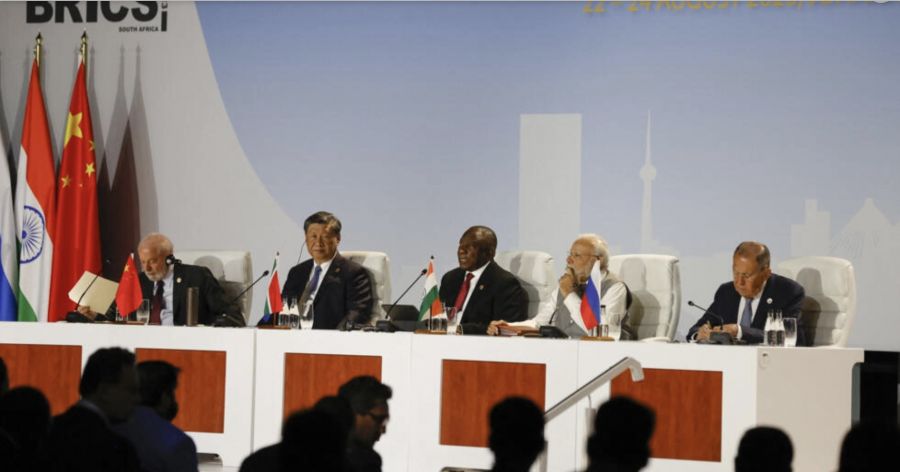
At around 9 a.m. local time on the 24th, the scheduled meeting was postponed, and a special press conference of the 15th BRICS Summit, added at short notice, went down in history.
The meeting announced the invitation of Saudi Arabia, Egypt, the United Arab Emirates, Argentina, Iran and Ethiopia to become full members of the BRICS family. Applause and gasps of surprise echoed through the room. The number in this expansion exceeded many countries’ expectations, yet it was “a matter of course, with the melon falling when ripe.” Whether BRICS has a bright or dim future, vigorous or fading vitality, the answer goes without saying. Amid the profound changes unseen in a century, more and more countries are standing together and uniting.
Bullish on BRICS, bullish on Africa. Following China’s gaze, some Western countries are now turning their attention to what they had “overlooked with an arrogant eye.” Of Africa, President Xi has stressed time and again that it is a land of great promise, a running lion. At the China-Africa Leaders’ Dialogue, Nigerian Vice President Kashim Shettima said with feeling: “We respect you deeply, and our admiration for you is sincere. China has always respected us, and we firmly support China.”
Chadian Prime Minister Saleh Kebzabo said: “President Xi, we must break the old model of a hundred years. With you, we are full of confidence. Against colonialism and neo-colonialism, China works sincerely with Africa so that Africa can truly achieve its own development.”
Just as history always advances in spirals and waves, the road ahead is not all smooth plain. At this BRICS Summit, a remark by President Xi struck a wide chord:
“Most emerging market countries and developing countries have emerged from the historical morass of colonialism. Through untold hardships and enormous sacrifices, we won national independence and have kept exploring development paths suited to our own national conditions. Everything we do is, in the final analysis, to enable our people to live a happy life. But some countries are unwilling to accept the loss of their hegemonic position and wantonly besiege and suppress emerging market countries and developing countries. Whoever develops well, they try to contain; whoever catches up, they trip up. I have said many times that blowing out someone else’s lamp will not make your own brighter.”
“As a developing country and a member of the Global South, China has always shared a common breath and a common destiny with other developing countries, firmly safeguarding the common interests of developing countries and working to increase the representation and voice of emerging market countries and developing countries in global affairs. China has no gene for seeking hegemony, no impulse for great-power rivalry; it stands firmly on the right side of history and firmly upholds the principle that ‘when the Great Way prevails, the world is for all.'”