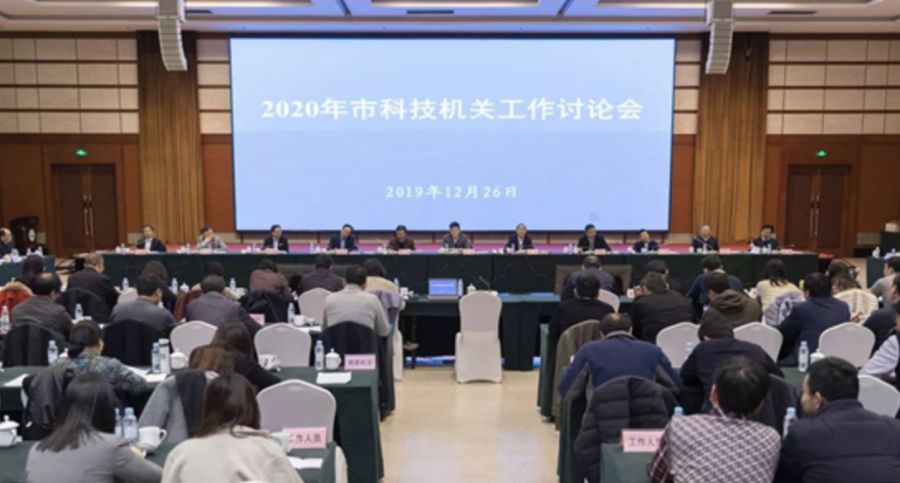
On the morning of 29 September, the State Council Information Office (SCIO) held a press conference focusing on the “14th Five-Year Plan for Building Shanghai into a Science and Technology Innovation Center with Global Influence”, at which Lin Nianxiu, Vice Chairman of the National Development and Reform Commission (NDRC), Li Meng, Vice Minister of Science and Technology, Zhang Tao, Vice President of the Chinese Academy of Sciences, and Wu Qing, Member of the Standing Committee of the Shanghai Municipal Party Committee and Vice Mayor, were invited to brief the press on the work of accelerating the building of a science and technology innovation center with global influence in Shanghai and to answer questions. Here is the transcript↓
On the morning of 29 September, the State Council Information Office (SCIO) held a press conference focusing on the “14th Five-Year Plan for Building Shanghai into a Science and Technology Innovation Center with Global Influence”, at which Lin Nianxiu, Vice Chairman of the National Development and Reform Commission (NDRC), Li Meng, Vice Minister of Science and Technology, Zhang Tao, Vice President of the Chinese Academy of Sciences, and Wu Qing, Member of the Standing Committee of the Shanghai Municipal Party Committee and Vice Mayor, were invited to brief the press on the work of accelerating the building of a science and technology innovation center with global influence in Shanghai and to answer questions. Here is the transcript↓
Lin Nianxiu:General Secretary Xi Jinping attaches great importance to the building of regional innovation highlands and has made it clear that the law of a high concentration of innovation in certain regions must be followed so as to form several regional innovation platforms that demonstrate and drive innovation. Keeping the overall situation in view, grasping the general trend and coordinating the domestic and international situations in an all-round way, the General Secretary personally planned, personally deployed and personally promoted the establishment of three international science and technology innovation centers — Beijing, Shanghai and the Guangdong-Hong Kong-Macao Greater Bay Area — as well as four comprehensive national science centers — Huairou, Zhangjiang, Hefei and the Greater Bay Area.
Wu Qing:Since the 13th Five-Year Plan period, the Shanghai Municipal Party Committee and the Shanghai Municipal Government have implemented the spirit of General Secretary Xi Jinping’s important instructions, and with the support of the NDRC, the Ministry of Science and Technology, the Chinese Academy of Sciences and other relevant national ministries and commissions, the Shanghai center’s capacity to gather innovation resources, the influence of its scientific and technological achievements, its leadership in emerging industries, its attractiveness as an innovation environment and its regional radiating and driving force have all been comprehensively enhanced. In particular, the concentration and visibility of the Zhangjiang Comprehensive National Science Center have continued to rise and national laboratories and major national science and technology infrastructure are being built faster; major original scientific and technological achievements have emerged in competition — for example, in 2020 Shanghai scientists published 32% of the country’s papers in the world’s top academic journals Nature, Science and Cell, one marker among them; major national science and technology tasks are also being implemented faster, with participation in the completion of major projects such as Jiaolong, Xuelong, Tiangong, Beidou, Tianyan (FAST), Mozi and the large aircraft; the building of the “three highlands” of integrated circuits, biomedicine and artificial intelligence is being accelerated — for instance, a number of important scientific and technological products and advanced processes such as etching machines have made major breakthroughs, and major original products in biomedicine such as the original new drug for Alzheimer’s disease “GV-971” and advanced molecular imaging equipment such as panoramic PET/CT have also been approved for the market; the building of the innovation chain, industrial chain and supply chain is being accelerated in terms of stabilizing, consolidating and strengthening the chains, and R&D centers of multinational companies are further concentrating in Shanghai; the attractiveness of high-level talent continues to rise — according to assessments by the relevant departments, Shanghai ranks first in the country in both the quantity and the quality of foreign talent introduced, and has been named “China’s most attractive city in the eyes of foreign talent” for eight consecutive years. By the end of the 13th Five-Year Plan period, the basic framework of the Shanghai center had been formed, laying a solid foundation for the building of the science and technology innovation center to reach a new level during the 14th Five-Year Plan period.

Lin Nianxiu:General Secretary Xi Jinping attaches great importance to the building of major science and technology infrastructure, and in many important speeches, including his New Year addresses, he has mentioned major facilities such as China’s Tianyan (FAST) and the China Spallation Neutron Source. In February this year, during an inspection and survey in Guizhou Province, when hearing a report on China’s Tianyan, the General Secretary pointed out clearly that major national science and technology infrastructure are the country’s important instruments and that planning guidance must be strengthened and construction pushed forward with all efforts. The NDRC has earnestly implemented the spirit of the General Secretary’s important instructions and, in accordance with the decisions and arrangements of the Party Central Committee and the State Council, has made every effort to promote the layout and construction of major science and technology infrastructure. It should be said thatthe construction and operation of China’s major facilities have entered a stage of high-quality development, showing three new characteristics.
First, the pace of construction has clearly accelerated.We have continuously stepped up overall coordination and pushed for all projects in the 13th Five-Year Plan to start construction within the plan period, including the Hard X-ray Free Electron Laser Facility, the Multi-Modal Cross-Scale Biomedical Imaging Facility and the Comprehensive Research Facility for Key Systems of Fusion Reactor Hosts. At the same time, we have also successfully completed the acceptance of a batch of major facilities already built, including the airborne remote sensing system, the Soft X-ray Free Electron Laser and the steady-state high magnetic field. Up to now, the overall scale and level of the major facilities that China has laid out and built are already at the forefront internationally, second only to the United States in number. At the same time, we adhere to the principle that “plans follow strategy, projects follow plans and factors follow projects”, and increase the support of factors such as funding and talent, precisely to ensure that these major facilities can be completed and put into operation as soon as possible and bring their effects into play. Let me give you an example: during the 13th Five-Year Plan period, total investment in building major national science and technology infrastructure increased nearly threefold compared with the 11th Five-Year Plan period, a clear increase in the amount of investment.
Second, the level of results has markedly improved.Since the 13th Five-Year Plan period, the construction and operation of China’s major facilities has gradually shifted from mainly following others to following and running alongside them, and some have already taken the lead, producing a large number of major original results and giving birth to a batch of strategic industrial technologies. Let me give you an example: with experimental means at the Shanghai Synchrotron Radiation Facility, Weyl semimetals were discovered and Weyl fermions were shown to scientists for the first time; the Experimental Advanced Superconducting Tokamak (EAST) set world records of 101 seconds of sustained high-confinement plasma discharge and a plasma core electron temperature of 100 million degrees Celsius. Some time ago I went to the site of a major facility to carry out research and saw scientists working intensively; I believe major breakthroughs will be made in the future. This is truly inspiring, and it is an important step forward in promoting the effective development and utilization of fusion energy in our country.
Third, social influence has been increasingly expanded.On the one hand, relying on major facilities, a number of major science and technology problems related to industrial innovation and development and to people’s livelihood have been solved. The Shanghai Synchrotron Radiation Facility has opened up new ways for the efficient use of natural gas and shale gas, providing strong support for energy security. The Shanghai Protein Science Research Facility has resolved the structure of the SARS-CoV-2 virus, effectively helping epidemic prevention and control and vaccine development. The Lanzhou Heavy Ion Research Facility has developed a heavy-ion cancer treatment device, achieving a major breakthrough in China’s independent development of high-end medical devices. The China Remote Sensing Satellite Ground Station and airborne remote sensing aircraft can transmit and process remote sensing observation data in real time and near real time, providing strong data support for resource surveys and environmental monitoring and first-hand data for flood fighting and disaster relief and earthquake rescue. On the other hand, major facilities have attracted and trained a large number of leading figures worldwide who understand science, technology, engineering and management, and have played a very important role in carrying out international innovation cooperation and enhancing the influence of China’s science and technology innovation.
Next, the NDRC will further thoroughly implement the spirit of General Secretary Xi Jinping’s important instructions and written comments, persist in facing the world’s science and technology frontier, the main battlefield of the national economy, the major needs of the country and the life and health of the people, persist in concentrating objectives, fields, entities, regions and resources, strengthen top-level design and unified planning, and, during the 14th Five-Year Plan period and with greater efforts, accelerate the layout of a batch of higher-level and larger-scale major science and technology infrastructure, promote their tendency to gather towards the three major international science and technology innovation centers such as Shanghai and the four comprehensive national science centers such as Zhangjiang, support regional innovation highlands and continuously improve the level of original innovation.We will focus on three areas of work:
First, accelerate the construction of major facilities already under way.We will increase central-local coordination, do a good job in guaranteeing the factors for facilities already under construction at the Shanghai center, such as the high-efficiency low-carbon gas turbine and the seabed observation network, coordinate and solve difficulties and problems in the construction process, and push for the facilities to be completed and to play their role as soon as possible.
Second, increase the openness of major facilities already in operation.We will earnestly do a good job in the open sharing of facilities such as the protein science research installation and translational medicine research of the Shanghai center, support researchers in producing more major original results based on major facilities, solve “bottleneck” problems in key areas and support industrial innovation and development.
Third, push for the start of construction of facilities planned for the 14th Five-Year Plan.For the major facility projects explicitly laid out in Shanghai in the 14th Five-Year Plan for major national science and technology infrastructure, the NDRC will support the Shanghai Municipal Government in promptly carrying out preliminary work, strive to start construction as soon as possible and provide strong support for building a science and technology innovation center with global influence.

Wu Qing:Strengthening the source function of science and technology innovation is the central government’s core positioning of and strategic requirement for building the Shanghai center.General Secretary Xi Jinping has required Shanghai to strengthen the source function of science and technology innovation, strive to achieve the leap from nothing to something in new scientific discoveries, new technological inventions, new industrial directions and new development concepts, and become the first discoverer of scientific laws, the first creator of technological inventions, the first pioneer of innovative industries and the first practitioner of innovative concepts. This has provided the fundamental guidance for building the Shanghai center and is also the main line we must always adhere to in building Shanghai into a science and technology innovation center with global influence.
Strengthening the source function of science and technology innovationis also an inevitable requirement for Shanghai to accurately grasp the new development stage, implement the new development philosophy and serve the new development pattern.Innovation is placed first among the development concepts and is the primary driving force leading development. Strengthening original innovation and enhancing the capacity for originating innovation are the key to promoting innovation from “0” to “1” and from nothing to something. Our country is embarking on a new journey of comprehensively building a modern socialist country and accelerating its entry into the front ranks of innovative countries, and there is an urgent need to strengthen the capacity for independent innovation, make up for shortcomings and narrow the gap as soon as possible. The next 15 years are also a critical period of leapfrogging in building the Shanghai center, and there is an urgent need to enhance its function of innovation origination and its global influence. At the same time, under the new development pattern, Shanghai is striving to build itself into the central node of the domestic circular flow and the strategic link of the domestic-international dual circulation. Using its advantages in all fields, Shanghai will play the role of central node and strategic link in the new development pattern, which inevitably requires Shanghai to use its capacity for innovation origination to promote more breakthroughs in key core technology fields, build safer and more stable industrial and supply chains, release and create new and greater demand, promote a smoother domestic circulation and help China shape new advantages in the international circulation.
The Plan firmly focuses on the main line of “strengthening the source function of science and technology innovation” and strives to achieve the “four news”. In terms of new scientific discoveries, it is necessary to strengthen forward-looking layout in major strategic fields, build high-level basic research forces, accelerate original breakthroughs in basic research and produce more original innovation. For new technological inventions, what matters is to build a new type of nationwide system that combines market-based and government investment in collaboration, fight the battle for key core technologies and accelerate the transformation of scientific and technological achievements into real productive forces. For new industrial directions, the main thing is to give play to the role of enterprises as the main body of innovation, create new momentum for high-quality industrial development and support and lead the development of key industries and frontier industries. For new development concepts, the focus is to uphold the core concept of “people’s cities built by the people, people’s cities for the people”, use frontier technologies to build a digital and smart city, a safe and resilient city, a green and low-carbon city and a healthy and vibrant city, promote the comprehensive digital transformation of mega-cities in the three fields of economy, life and governance, improve the effectiveness of modern urban governance and further enhance people’s well-being.

Li Meng:Strengthening strategic scientific and technological strength is a major task in building the Shanghai center. Building an innovative country cannot be separated from the support and leadership of a number of innovation highlands; Shanghai is a national science and technology innovation highland, and national strategic scientific and technological strength is the high end of Shanghai’s science and technology innovation. During the 13th Five-Year Plan period, as one of the country’s three major international science and technology innovation centers, Shanghai achieved remarkable results in its construction. Not long ago, the World Intellectual Property Organization (WIPO) published data showing that China’s comprehensive innovation capacity ranking rose to 12th in the world and Shanghai ranked 8th among the world’s top 100 science and technology clusters. This shows that the Shanghai international science and technology innovation center has played a supporting and leading role in building our innovative country, and the national strategic scientific and technological strength in Shanghai has contributed to this. During the 14th Five-Year Plan period, the Ministry of Science and Technology will benchmark against the requirements of national scientific and technological self-reliance and self-strengthening, take strengthening national strategic scientific and technological strength as the guide, further support Shanghai in accelerating the building of an international science and technology innovation center, especially in building a Yangtze River Delta science and technology innovation community, enhance the origination function of science and technology innovation and high-end industries and form an important pole in building an innovative country. There are roughly the following arrangements and deployments:
First, accelerate the building of major science and technology innovation platforms and enhance Shanghai’s capacity for original innovation.Strategic scientific and technological strength should first of all be about strengthening strategic capacity and basic capacity, and platforms are an important embodiment of these two capacities. We will support Shanghai in focusing on major national strategic objectives, building national laboratories in relevant fields and carrying out strategic, forward-looking and basic major scientific research layouts. At present, the state has established 45 national key laboratories in Shanghai, involving frontier fields such as next-generation information technology, life and health, artificial intelligence and advanced manufacturing. In accordance with General Secretary Xi Jinping’s instructions, the Ministry of Science and Technology is reorganizing the national key laboratory system and will include these national key laboratories built in Shanghai in the reorganization process to further enhance systematic capacity. We will also support the rapid development of research institutes, high-level research universities, new types of R&D institutions and science and technology enterprises in Shanghai, accelerate the layout of a batch of basic science research centers, promote the systematic improvement of talent training, discipline building, scientific research and enterprise innovation capacity, and comprehensively enhance the requirement of strengthening the capacity for innovation origination proposed in the 14th Five-Year Plan.
Second, promote Shanghai’s deep participation in the R&D and problem-solving of major national science and technology projects.Strategic scientific and technological strength must first take on the strategic tasks of the state and society; otherwise it would not be called strategic scientific and technological strength. We will join with relevant departments to support Shanghai in giving play to its advantages of a strong basic capacity and a strong research team (strong talent), undertake R&D tasks of major projects of Science and Technology Innovation 2030 — such as brain science and brain-inspired research, quantum communication and quantum computers — explore central-local coordination mechanisms, work with relevant departments to strengthen the combination of industry, academia and research and the coordination of science and education, and build an innovation consortium led by enterprises for tackling key core technologies. We will also innovate the management and service methods of science and technology projects, including implementing new organizational methods for project R&D such as “open competition to select the best candidate”, the “horse racing system” and the “lump-sum contract system”, and continuously enrich the organizational models of major scientific research projects.
Third, with Shanghai as the leader, strengthen the building of the Yangtze River Delta science and technology innovation community and create a new engine for future industries.In creating a new engine for industrial development in the Yangtze River Delta, Shanghai plays a leading and driving role. We will support Shanghai in taking the lead, with the “three provinces and one municipality” of the Yangtze River Delta jointly building the Yangtze River Delta National Technology Innovation Center, making the Yangtze River Delta science and technology innovation community stronger, more solid and bigger, and, in areas such as integrated circuits, carbon fiber and composite materials, marine engineering equipment and precision medicine, cultivating national technology innovation centers and national clinical medicine centers. Focusing on the “three highlands” of integrated circuits, biomedicine and artificial intelligence, we will jointly set up a Yangtze River Delta joint research fund, formulate joint research implementation plans, jointly transform scientific and technological achievements, accelerate the filling of shortcomings in Shanghai’s key core technologies and forge strong points for the development of future industries. We will give full play to the role of the national new-generation artificial intelligence innovation and development demonstration zone as a carrier. We will promote the combination of science and technology with finance, take “science and technology innovation + finance + industry” as the handle, support the development of science and technology industries in the G60 science and technology innovation corridor and boost Shanghai’s accelerated march towards the high end of the global innovation chain, industrial chain and value chain.
Fourth, support Shanghai’s deep integration into the global innovation network.National strategic scientific and technological strength should play an important role in carrying out international science and technology cooperation, and Shanghai has advantages in this respect. We are arranging for Shanghai to organize and implement the international big science program on the whole-brain mesoscopic neural connection map, gathering top scientists and teams from around the world to carry out joint brain science research. We will support Shanghai in running international forums such as the Pujiang Innovation Forum and the World Artificial Intelligence Conference well, forming important platforms and brands for international exchange and cooperation, and also support the Minhang international-oriented demonstration zone for the transfer and transformation of achievements in Shanghai, forming a hub for the transfer and transformation of scientific and technological achievements that connects internationally. This work has been under way for many years and has progressed relatively quickly in recent years, especially in supporting the building of the Shanghai international technology trading market. Since the official launch of the international technology trading market in June 2020, it has attracted more than 14 million patented technologies, and more than 4,000 science and technology enterprises and 547 service institutions have registered, with intended investment reaching 16.9 billion yuan. In short, Shanghai’s science and technology innovation should be globally oriented and benchmarked against the world, and strive to build itself into a place where global innovation needs are released, a gathering place for global innovation achievements and an important node of the global technology factor market.
Fifth, support Shanghai in gathering high-end talent.The key to strategic scientific and technological strength is strong talent. At the talent work conference held by the Central Committee yesterday, General Secretary Xi Jinping delivered an important speech, which we are earnestly studying and understanding and researching how to implement. In building the Shanghai international science and technology innovation center, we will always uphold and implement General Secretary Xi Jinping’s new concepts, new strategies and new measures on talent work in the new era, accelerate the building of an important world talent center and innovation highland, and support Shanghai in implementing more scientific and efficient talent training and cultivation policies and more attractive overseas talent policies, including fully stimulating the various innovation entities in Shanghai and giving play to their main role in attracting high-end talent. We will support giving Shanghai greater autonomy in the system for attracting foreigners to work in Shanghai, and further relax restrictions on age, educational qualifications and other conditions for foreign science and technology talent urgently needed for building the Shanghai center, including when applying for work permits, and also support Shanghai in taking the lead in carrying out institutional and mechanism reform and policy experiments for the development of science and technology talent, strengthening its radiating and driving role.

Zhang Tao:Building a science and technology innovation center with global influence in Shanghai is a major strategic deployment of the Party Central Committee. As the country’s strategic scientific and technological strength, the Chinese Academy of Sciences keeps “national affairs” in mind and shoulders “national responsibilities”, and plays a core, backbone and leading role in building the Shanghai center. Key measures will include the following:
First, focus on the source function of science and technology innovation.The Chinese Academy of Sciences will further increase the layout of frontier basic and emerging interdisciplinary directions. It will actively undertake more major science and technology tasks, achieve original breakthroughs from “0” to “1”, advance the building of a cluster of major science and technology infrastructure led by the Shanghai Synchrotron Radiation Facility, promote the open sharing of facilities and provide important technical support for China’s high-level original innovation and breakthroughs in key core technologies. In important fields such as life sciences, it will proactively plan and take the lead in launching major international science programs.
Second, focus on building the three major industrial innovation highlands.The Chinese Academy of Sciences will focus on industries such as integrated circuits, biomedicine and artificial intelligence, support the building of the Shanghai Institute of Integrated Circuit Materials to form a domestically leading innovation platform for integrated circuit materials, continue to promote the building of innovation platforms such as the Lingang satellite development base of the Innovation Academy for Microsatellites and the G60 Brain Intelligence Science and Technology Innovation Base, and support the development of important carrier areas such as the science and technology innovation center.
Third, focus on building the science and technology innovation talent team.Following the laws of talent growth and taking multiple measures simultaneously, we will strive to build top science and technology talent, leading talent teams and key core technology tackling teams. We will strengthen the orientation of talent policy, build a distinctive talent work system, stimulate the vitality of science and technology innovation, support ShanghaiTech University in building a high-level, internationalized, small-scale research university, explore innovative talent training models and forge a reserve team for science and technology.
Fourth, deepen the institutional and mechanism reform of research institutes.We will push the Chinese Academy of Sciences’ research institutions in Shanghai to take the reorganization of national key laboratories as the driving force. Focusing on enhancing core competitiveness and overall coordination capacity, we will accelerate the improvement of the scientific research organizational structure, innovate the organization and management model of major scientific research activities, establish a science and technology evaluation system adapted to the new development stage, carry out pioneering and pilot work in the reform of some key areas and key links, and form a number of reform measures with a demonstration effect.

Zhang Tao:As you all know, the Central Talent Work Conference was held yesterday, and we are also studying and understanding General Secretary Xi’s instructions and requirements. Next, the Chinese Academy of Sciences will roll out more measures to strengthen talent work. At present, we have the following key tasks:
First, strengthen the attraction and cohesion of top-notch talent for the science and technology innovation center.We must focus in particular on a global perspective. The Chinese Academy of Sciences is a “national team” and a research institution with great influence in the world, so in introducing talent we should not focus only on the domestic market but introduce high-level talent with a global perspective. In particular, we must highlight the demand orientation and attract talent with more proactive, more open and more effective talent introduction policies. We must especially strengthen the brand and other distinctive advantages of the “Hundred Talents Program”, which the Chinese Academy of Sciences has adhered to for many years, focus on frontier basic original innovation and the tackling of key core technologies, and introduce talent precisely according to needs and with high standards. We encourage innovative ways of introducing talent, strengthen the introduction of top talent and high-level talent in key core fields, and increase the introduction of outstanding young talent and urgently needed key talent.
Second, strengthen the training of science and technology leaders through the layout of major scientific research strategies.We have recently launched the “Program for Stable Support of Youth Teams in Frontier Basic Fields” and the “Key Research Program in Frontier Science”, using such programs and such projects to train top scientists with international influence, and in particular, in conjunction with the organization and implementation of major tasks such as major engineering and scientific problems and breakthroughs in key core technologies, to train and bring up world-class science and technology talent and research backbones.
Third, increase support for young talent.Recently the Chinese Academy of Sciences has taken a series of measures to increase the training of young research talent, such as increasing funding for research projects and encouraging young people to temper themselves in major science and technology breakthroughs and important posts. During the 14th Five-Year Plan period, among the laboratory directors and deputy directors newly appointed by each institute, in principle no less than 50% should be under 40 years old; this is to give more young scientists opportunities for training and growth. In addition, we implement the “two-chief system” in pilot special projects to create conditions and provide a stage for the growth of outstanding research backbones. In the newly deployed strategic pilot special projects, no less than 30% will be led by people under 45, and no less than 50% of project leaders will be people under 45, and we will strive to use more than 50% of the relevant basic research projects within the academy to support young talent under 35.
Fourth, expand international cooperation in talent exchange and promote the internationalization of talent in the science and technology innovation center.We will establish an open and inclusive international talent and governance sharing mechanism, attract outstanding talent from foreign universities, research institutions and enterprises to come to Shanghai and to the Chinese Academy of Sciences for cooperative research, build innovation cooperation nodes for global science and technology talent exchange, explore and innovate ways of introducing and managing foreign talent, and actively use multilateral cooperation mechanisms such as leading the launch of big science programs — that is, large international cooperation programs led by the Chinese Academy of Sciences — to attract, train and gather outstanding science and technology talent from around the world to work in China, in Shanghai and at the Chinese Academy of Sciences.

Lin Nianxiu:General Secretary Xi Jinping attaches great importance to building the Shanghai center and has stressed on many occasions that Shanghai should provide high-level innovation supply, accelerate the transformation of scientific and technological achievements into real productive forces and support high-quality development across the country. During the 14th Five-Year Plan period, the NDRC will focus on promoting the “improvement of four capacities” to systematically support the Shanghai center in enhancing its innovation level and leading and driving high-quality development across the country.
First, further enhance the core supporting capacity of the Zhangjiang Comprehensive National Science Center.During the 14th Five-Year Plan period, we plan to continue strengthening the building of the Zhangjiang Comprehensive National Science Center from three aspects. First, issue a plan. Recently, the NDRC and Shanghai, together with the Ministry of Science and Technology, the Chinese Academy of Sciences and other units, are stepping up the formulation of the 14th Five-Year Plan for the Zhangjiang center, studying and clarifying the major tasks for building the science center in the coming period, and striving to push the innovation level of the center to a new level through the 14th Five-Year Plan construction. Second, lay out another batch of projects. We will continue to lay out a batch of major science and technology infrastructure, especially in fields such as photonic science and life sciences, to promote the formation of a more complete cluster of major facilities. Third, strengthen output. Through methods such as “open competition to select the best candidate” and “horse racing”, we will support various research entities in undertaking key core technology tackling tasks and major scientific research projects, and promote the output of more world-class original results.
Second, further enhance the development-leading capacity of the three major industrial innovation highlands.We will accelerate the building of the three major industrial highlands of integrated circuits, biomedicine and artificial intelligence, strive to achieve “three breakthroughs and improvements” and accelerate the march towards the high end of the global innovation chain, industrial chain and value chain. These are Shanghai’s three major tasks during the 14th Five-Year Plan period, and we will accelerate them. First, in integrated circuits, we will focus on achieving breakthroughs and improvements in chip R&D, equipment and materials, and manufacturing processes. Second, in biomedicine, we will focus on achieving breakthroughs and improvements in clinical validation and translation and the application of new products. Third, in artificial intelligence, we will focus on achieving breakthroughs and improvements in basic theory, common technologies and social governance.
Third, further enhance the institutional guarantee capacity for comprehensive innovation reform.We will adhere to the “dual drive” of institutional innovation and science and technology innovation and provide strong institutional guarantees for building the science and technology innovation center through deepening reform. First, continue to advance comprehensive innovation reform. We will support Shanghai in deepening a new round of comprehensive innovation reform centering on key tasks such as industrial innovation talent, the management of scientific and technological achievements and the transformation of scientific and technological achievements, and provide experience and demonstration for the whole country. Second, continue to push the pilot reform of the transformation of scientific and technological achievements at Shanghai Jiao Tong University to go deeper and become more solid. As I said just now, all seven pilot tasks must be completed; two of them are still being pursued, and we will strive to complete these two tasks in full during the 14th Five-Year Plan period. We will untie the “thin ropes” that bind researchers and strive to form more “Xiaogang Village”-style institutional results in the reform of the science and technology system.
Fourth, further enhance the demonstration and driving capacity of innovation and entrepreneurship.We will support Shanghai in accelerating the building of an ecosystem for the integrated innovation of large, medium and small enterprises, providing effective demonstration and driving for the science and technology innovation center to enhance its innovation vitality and capacity. There are mainly two aspects here: first, strengthen base building. We will vigorously support the distinctive and professional development of dual-innovation demonstration bases, incubators and makerspaces, and attract and gather more researchers, corporate executives and returned students to innovate and start businesses in Shanghai. Second, strengthen the creation of an atmosphere. We will support Shanghai in running a series of activities such as National Mass Entrepreneurship and Innovation Week and “Innovate China” well, optimize the policies, systems and environment supporting innovation and entrepreneurship, and stimulate the vitality of various innovation entities to a greater extent.

Wu Qing:Shanghai has proposed that by 2035 it will comprehensively enhance its level as an international center of economy, finance, trade, shipping and science and technology innovation, as well as a cultural metropolis, further strengthen the “four functions” and basically complete the building of a socialist modern international metropolis with world influence. During the 13th Five-Year Plan period, Shanghai actively promoted the deep integration of building the science and technology innovation center with urban development, effectively serving the enhancement of the city’s level and core competitiveness. For example, a series of efforts were made in using technological innovation to promote the rapid development of high-end industries. At the same time, during the epidemic, three batches of 19 emergency science and technology tackling tasks were laid out to help epidemic prevention and control. We deepened the empowerment of urban digital transformation by science and technology, strongly supporting the building of “one-network handling” for government services and “one-network unified management” for urban operations. During the 14th Five-Year Plan period, the Shanghai center will focus on strengthening the city’s “four functions”, which is of great significance not only to building Shanghai as an international metropolis but also to the high-quality development of the Yangtze River Delta and the whole country, further bringing into play the comprehensive and spillover effects. Among them, it directly serves the strengthening of the innovation origination function and effectively supports the improvement of the following three functions:
In terms of strengthening the function of global resource allocation,Shanghai will actively enhance its capacity to allocate innovation factor resources such as talent, technology and rules. For example, it will formulate efficient and precise talent introduction policies, create a “magnetic attraction effect” for global high-level talent, and train an internationalized talent team with a global perspective, independent innovation capacity and experience in global science and technology governance. It will encourage science and technology enterprises to “go global”, lay out R&D centers and innovation centers around the world, explore the initiation and establishment of international science and technology organizations, participate in or initiate international big science programs and big science projects, participate in the formulation of international standards, and enhance the global influence of international events such as the World Laureates Forum and the World Artificial Intelligence Conference.
In terms of strengthening the leading function of high-end industries,Shanghai has proposed that by 2025 the added value of strategic emerging industries should account for more than 20% of the city’s GDP and exceed 1 trillion yuan. To achieve this goal, we will further intensify scientific and technological problem-solving, accelerate breakthroughs in a batch of key core technologies, provide high-level science and technology innovation supply, and support and lead the high-quality development of industries. The Plan proposes a key core technology tackling layout of “3+8+X”, which is both a matter of finding the right point of accumulated strength in the current tide of scientific and technological progress and laying the foundation for China’s medium- and long-term sustained economic growth, and a way of attracting more innovators and entrepreneurs interested in emerging science and technology R&D to Shanghai to seek development together.
In terms of strengthening the function of an open hub and gateway,We will further expand opening up, support well-known international science and technology organizations and international research institutions in setting up branches in Shanghai, support foreign investors in setting up R&D centers in Shanghai, and plan to have about 560 foreign-funded R&D centers in Shanghai by the end of the 14th Five-Year Plan period, compared with 500 at present. We will further encourage foreign-funded enterprises and local R&D institutions to form R&D alliances or joint R&D institutions. We will attract global venture capital institutions to establish a presence in Shanghai and support the development of start-up science and technology enterprises.

Wu Qing:Creating an open and collaborative innovation space and building a higher-level global innovation network is an important task in building the Shanghai center during the 14th Five-Year Plan period. The Plan proposes adhering to equal emphasis on “bringing in” and “going global”, further optimizing the environment for open cooperation and advancing all-round, high-level global science and technology innovation cooperation.
In terms of bringing in, we welcome more foreign-funded enterprises to deeply participate in building the Shanghai center and share the opportunities of innovation and development.Foreign-funded enterprises are an indispensable and important force in Shanghai’s building of the science and technology innovation center, and the scale of their innovation input and the quality of their innovation output occupy an important position in Shanghai’s innovation system. For example, the R&D expenditure of foreign-invested industrial enterprises above designated size accounts for more than 40% of the R&D expenditure of industrial enterprises above designated size in the city; the sales revenue of new products accounts for more than 50%; and expenditure on the introduction of overseas technology accounts for more than 80%. In particular, Shanghai’s foreign-funded R&D centers had reached a cumulative total of 500 by the end of August this year, forming a certain agglomeration effect. At the end of last year we issued the “Provisions of Shanghai Municipality on Encouraging the Establishment and Development of Foreign-funded R&D Centers”, introducing a series of measures in areas such as cross-border R&D customs clearance, cross-border financial services, entry, exit and residence, registration, industry-university-research cooperation, transformation of results and intellectual property protection. In the Plan, we propose the development goal of a cumulative total of 560 foreign-funded R&D centers in Shanghai by 2025. During the 14th Five-Year Plan period, we will also build a more open and inclusive innovation ecosystem, introduce more foreign-funded enterprises to set up R&D centers in Shanghai, and actively support foreign-funded R&D centers in upgrading their level and strengthening their functions.
In terms of going global, we will actively build a multi-entity, multi-level and multi-type network for external science and technology exchange and cooperation.For example, we will strengthen international dialogue and exchange around hot and key science and technology fields. We will use Shanghai’s sister-city network and other channels to consolidate and expand intergovernmental science and technology innovation cooperation. We will encourage enterprises, universities, research institutes and other innovation entities to actively integrate into the global innovation network, innovate under open conditions, build a number of high-quality international joint laboratories and explore new models of science and technology park cooperation. We will enhance the brand effect and international influence of innovation activities such as the Pujiang Innovation Forum, the World Laureates Forum and the International Innovation and Entrepreneurship Competition. In addition, we will deeply implement “Belt and Road” science and technology innovation cooperation and strengthen science and technology, talent and people-to-people and cultural exchanges with countries around the world and relevant regions.

Lin Nianxiu:Since the 18th National Congress of the Communist Party of China, China has laid out and built three major international science and technology innovation centers and four comprehensive national science centers, forming a “3+4” regional innovation pattern. The so-called “3” refers to the three international science and technology innovation centers of Beijing, Shanghai and the Guangdong-Hong Kong-Macao Greater Bay Area. Among them, the Beijing center has concentrated a large number of high-quality science and education resources; as everyone knows, Beijing has the largest number of universities, research institutions and central state-owned enterprises in the country and possesses very rich and high-quality innovation resources. Its main task is to build a source of science and technology innovation for the whole country, and this is also an important mission of the Beijing center. The Shanghai center mainly focuses on building the three major industrial innovation highlands of integrated circuits, artificial intelligence and biomedicine, which have global influence and a voice; these three highlands are also the main tasks assigned to the Shanghai center by General Secretary Xi Jinping, to be gradually implemented in the future according to these three tasks. The Guangdong-Hong Kong-Macao Greater Bay Area center focuses on giving play to Guangdong’s advantages as a frontier of reform and opening up and to the high degree of internationalization of Hong Kong and Macao, and builds the world’s largest base for pilot validation and the application and promotion of achievements. The so-called “4” refers to the four comprehensive national science centers of Huairou in Beijing, Zhangjiang in Shanghai, Hefei in Anhui and the Greater Bay Area, which are the core support of the international science and technology innovation centers. Their main task is to build major science and technology infrastructure and high-level innovation platforms, integrate high-quality innovation resources and build a world-class highland of original innovation.
In recent years, under the strong leadership of the Party Central Committee, the role of the “3+4” regional innovation highlands has continued to emerge. Some of the results I have already mentioned above; below I will briefly introduce that role once more from the following four aspects.
First, they have provided a strategic pivot for building a new development pattern.As important sources of science and technology innovation and regional development growth poles, they radiate and drive domestic innovation and development, deeply participate in global science and technology industry competition and cooperation, and have played a key role in the domestic circular flow and the domestic-international dual circulation.
Second, they have provided a source of momentum for promoting high-quality economic development.By gathering a large number of high-level research institutions and innovative leading enterprises, they have become the main birthplace of high-quality supply and new demand and have played an important role as a driving engine.
Third, they have formed strong support for achieving high-level scientific and technological self-reliance and self-strengthening.Regional innovation highlands follow the law of innovation agglomeration, significantly enhance the capacity for original innovation and have become the main force in the country’s output of original major scientific and technological achievements and disruptive technologies.
Fourth, they have provided a model and demonstration for deepening the reform of the science and technology system.Regional innovation highlands give play to their advantages of active innovation and flexible institutions and mechanisms, make bold and proactive explorations and have become testing grounds for pilot reforms of the science and technology institutional and mechanism reform. These four roles are becoming more and more prominent.
Next, we will earnestly implement the decisions and arrangements of the Party Central Committee and the State Council, make unremitting efforts and accumulate achievements over time, and promote the formation of a systematic and multi-level overall layout in which international science and technology innovation centers take the lead, comprehensive national science centers provide core support and regional science and technology innovation centers complement each other’s advantages. In our future practical work, we will focus on grasping the following four aspects:
First, focus on national strategy and adhere to systematic planning.We will adhere to the principle of a single chessboard for the whole country, systematically plan the building of regional innovation highlands, and closely combine it with major national strategies, major tasks and major projects.
Second, base ourselves on comparative advantages and adhere to a layered layout.We will steadily and orderly advance all the work of building and developing the three major international science and technology innovation centers and the four comprehensive national science centers. At the same time, we will also steadily advance the building of regional science and technology innovation centers and lay out a number of regional science and technology innovation centers.
Third, respect the laws of innovation and strengthen concentrated support.Following the laws of scientific discovery, technological invention and innovation, we will coordinate the concentration of innovation factors such as funding, projects, talent and policies in advantageous regions.
Fourth, strengthen regional coordination and promote linked development.We will strengthen regional innovation cooperation and establish construction and operation mechanisms for collaborative innovation and linked development of regional innovation highlands.
Data source: official website of the State Council Information Office