On 6 December the Office for the Promotion of the Construction of Shanghai’s Science and Technology Innovation Centre held its eleventh plenary meeting, at which it reviewed this year’s progress in building the centre and studied ways to advance the development of Shanghai’s biomedicine and other industries.
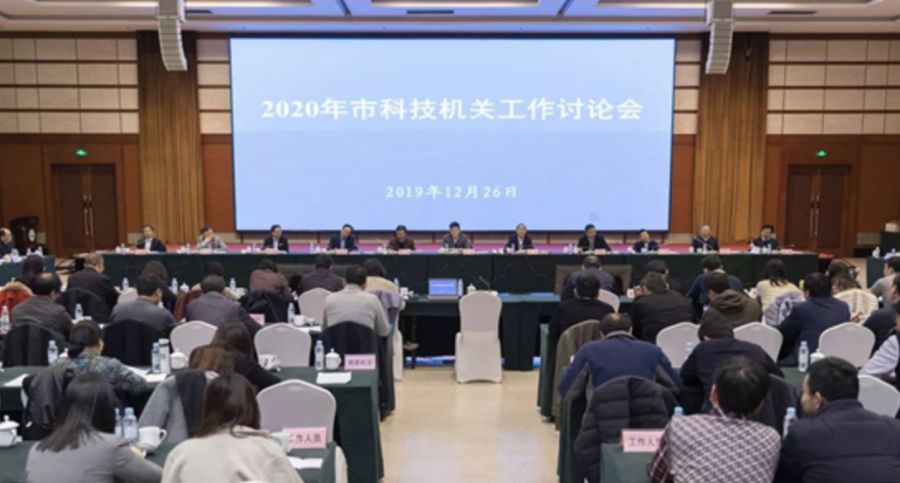
On 6 December the Office for the Promotion of the Construction of Shanghai’s Science and Technology Innovation Centre held its eleventh plenary meeting, at which it reviewed this year’s progress in building the centre and studied ways to advance the development of Shanghai’s biomedicine and other industries. Ying Yong, deputy secretary of the municipal party committee and mayor, and Lin Nianxiu, deputy director of the National Development and Reform Commission, jointly chaired the meeting and delivered speeches. Ying Yong pointed out that the important speech delivered by General Secretary Xi Jinping during his inspection of Shanghai provides the fundamental guideline for the city’s efforts to advance the building of the innovation centre. Next year is the year in which the basic framework of the innovation centre is to take shape; the city must hold firmly to its goals, redouble its efforts and push ahead at full strength so as to better play an innovation-leading and demonstration-radiating role. The biomedicine industry is one of the priority fields for Shanghai’s development: the city should consolidate its strengths, aim at the frontier, and accelerate its transformation into a hub of biomedical innovation with international influence, thereby contributing even more to serving the national strategy.
At the meeting, Wu Qing, member of the standing committee of the municipal party committee and vice mayor, reported on this year’s progress in the work of the Shanghai innovation centre and on the priorities for 2020. The National Development and Reform Commission reported on its work to promote the development of the integrated circuit, artificial intelligence and biomedicine industries. Plaques were unveiled for the Zhangjiang Fudan International Innovation Centre, the Fudan University National Platform for the Integration of Industry and Education in Integrated Circuits, the Shanghai Jiao Tong University Zhangjiang Science Park, and the Tongji University National Stem Cell Translational Resource Bank. Those attending the meeting included Lu Ming, member of the leading party group of the Ministry of Science and Technology; Tang Tao, vice minister of human resources and social security; Xiang Libin, vice president of the Chinese Academy of Sciences; Zhong Zhihua, vice president of the Chinese Academy of Engineering; Zong Ming, vice mayor of Shanghai; Jiao Yang, Jiang Sixian and Chen Jie, leaders of universities in Shanghai; and Shi Erwei, executive deputy director of the Office of the Shanghai Zhangjiang Comprehensive National Science Centre.
Ying Yong pointed out that the municipal party committee and municipal government attach great importance to building the innovation centre. Since the start of this year overall progress has been good: the capacity to originate innovation has continued to strengthen, high-quality innovation resources have been brought together faster, the innovation chain and the industrial chain have become more closely integrated, the ecosystem for innovation and entrepreneurship has been improved more quickly, and the municipal people’s congress is actively advancing legislation. Next year the main thrust must be to strengthen the function of scientific and technological innovation as a source of original ideas and to speed up the formation of the basic framework of the innovation centre. Key areas must be highlighted, with continued focus on Zhangjiang and, building on the Zhangjiang Comprehensive National Science Centre, a strategic high ground for innovation origination must be created. Key fields must be highlighted, with focus on integrated circuits, artificial intelligence and biomedicine, in an effort to make greater progress in breaking through key core technologies and fostering world-class clusters of emerging industries. Key links must be highlighted, with stronger institutional and systemic innovation in science and technology and greater efforts to create a better environment for innovation and entrepreneurship. The driving role of the “three major tasks and one major platform” must be brought into full play, and planning for Shanghai’s innovation centre over the next five years must be taken in hand promptly.
The biomedicine industry is a main thrust of China’s strategic emerging industries. With the strong support of all national departments, it is hoped that Shanghai will achieve greater breakthroughs in frontier fields and core key technologies of biomedicine, in clinical medical research, in fostering innovative leading enterprises, and in improving the industrial ecosystem.
Lin Nianxiu pointed out that this year has been one of deepening and advancing the building of the Shanghai innovation centre, in which a series of hard and concrete measures were introduced and a number of landmark results were produced. To form the basic framework of the innovation centre next year, the spirit of General Secretary Xi Jinping’s series of important speeches on scientific and technological work and of his important speech during his inspection of Shanghai must be taken as the fundamental guideline and carried through to the end, blueprint by blueprint. All departments must work together efficiently and strive to produce a batch of widely recognised landmark results, complete the first-phase tasks in full, and make Shanghai’s innovation system complete, its innovation capacity strong, its economic quality high and its innovation ecosystem lively. At the same time, more major tasks, major projects and major reforms should be entrusted to Shanghai, so that the next stage of building the innovation centre is better targeted and more visible. At present the global biomedicine industry stands at a historic juncture where the technological revolution and industrial transformation are achieving major breakthroughs; every effort must be made to support Shanghai in building a high ground for the biomedicine industry, to consolidate the core of original innovation, to conquer key core technologies and to implement major reform measures, so as to lead China’s biomedicine industry towards high-quality development.