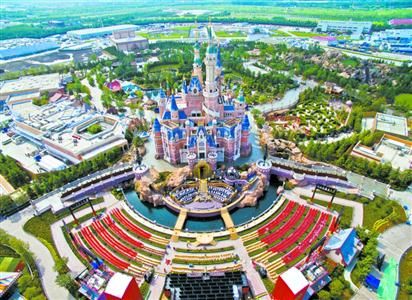
In just one year, Pudong’s cultural and creative industries jumped from being a longstanding weak spot to a new growth point for the economy. Disneyland alone drove a 54.3% rise in revenue in the leisure and entertainment category.
The latest statistics show that Pudong’s cultural and creative industries grew explosively in 2017, with value added for the year reaching 105.603 billion yuan, up 19.9%. Compared with the mere 2.6% growth of 2016, the increase was nearly ten times as large.
As Shanghai works at full strength to build its “cultural brand”, what is the secret behind the rapid rise of Pudong’s cultural and creative industries?
Industrial scale becomes more concentrated
Before 2017, the scale of Pudong’s cultural and creative industries had gone through four consecutive years of “low-altitude flying”; at its most sluggish, annual growth was only 2.6%. Yet according to the latest data published by the statistics bureau of the Pudong New Area Development and Reform Commission, in 2017 the revenue of enterprises above a designated size in Pudong’s cultural and creative industries reached 361.562 billion yuan for the year, with growth of 14%.
The overall scale of Pudong’s cultural and creative industries has expanded rapidly, and film and television, performing arts, art, online culture and other cultural and creative segments have all surged, with markedly better returns. Among them, the digital culture industry and the leisure and entertainment industry have the strongest momentum — Disneyland drove a 54.3% increase in revenue in leisure and entertainment; and led by a group of leading digital culture enterprises, Pudong has quickly formed a new industrial ecosystem, with the digital culture industry growing rapidly by 18% on a large base (about 40% of the whole district) and an average industry profit margin of 43.4%.
In only one year, Pudong’s cultural and creative industries have leapt from a former weak spot to a new growth point, and the industrial scale has further concentrated on its existing basis. In 2017, the number of cultural and creative industry parks in Pudong jumped by 15 to a total of 35. Among them, the two national-level parks, Zhangjiang and Waigaoqiao, stood out in driving industrial development. In 2017, cultural entrepreneurship in Zhangjiang Park generated operating revenue of 156.3 billion yuan, up 13.4%, accounting for 43% of the new area’s cultural and creative industries; the cultural trade function of the Waigaoqiao Free Trade Zone was raised by leaps and bounds, with nearly 500 enterprises settled in the National Base for International Cultural Trade, and the value of cultural products imported in the area accounting for nearly 40% of the city total.
Most surprising of all is the performance of the Jinqiao mobile video industry. With China Mobile and Tianyi Video as leaders, Jinqiao has accelerated the clustering of upstream and downstream enterprises; the mobile video industry now covers a fuller range of business categories and has grown rapidly, generating revenue of 5.5 billion yuan, up 39.5%.
Leading enterprises pioneer new business models
Pudong’s cultural and creative industries could take off in such a short time thanks to the leadership of a group of flagship enterprises. Over the past year, through the innovative transformation of heavyweight cultural and creative companies such as China Literature, Bilibili and Ximalaya FM, and their constant introduction of new business models that drive the development of the entire upstream and downstream industrial chain, Pudong has markedly strengthened its industrial advantages in cultural and creative industries, especially in digital culture.
In the first half of last year, China Literature Group — which has worked in Pudong for decades and focuses on a licensed digital reading platform and a platform for nurturing literary IP — achieved revenue growth of 92.5% year on year, hitting a new high of 1.9 billion yuan. By linking up the whole industrial chain and building a pan-entertainment cultural brand, outstanding literary works under China Literature have been adapted as IP into films, television dramas, animation, comics, stage plays and many other art forms.
The company’s head said that the television drama Fighter of the Destiny, adapted from an online novel under China Literature, has drawn nearly 30 billion views across all platforms, while animated works such as Battle Through the Heavens and The King’s Avatar keep breaking online viewing records, each surpassing the one-billion mark in total plays; the company has essentially established its industry-leading position in digital reading, copyright operation and other fields.
Similarly, the Ximalaya FM app, officially launched in 2013, also achieved great success through innovation last year, even giving rise to a new business model of paid knowledge. Vice president Zhang Tao said that in 2016 Ximalaya FM launched its paid knowledge business for the first time and on 3 December of that year launched the country’s first content consumption festival, the “123 Knowledge Carnival”, whose 24-hour sales exceeded 50 million yuan. On 1 December 2017 the second “123 Knowledge Carnival” opened, with sales over 72 hours reaching as high as 196 million yuan.
“We have succeeded in getting users to pay for knowledge, giving rise to a new profit model. Over the past year the company’s sales revenue reached 800 million yuan, making it one of the fastest-growing companies in the mobile internet field.”
A more relaxed and higher-quality development environment
The “take-off” of enterprise business is inseparable from an improved business environment. Pudong is now working hard, through a combination of policies and government services, to provide a more relaxed and higher-quality development environment for cultural and creative industries.
Last November, Pudong New Area issued a new round of measures for the management of special funds for cultural undertakings and industries (film and television). Over the next five years the new area’s finances will invest a cumulative 1.5 billion yuan to create the “Pudong New Area Publicity and Culture Development Fund” and the “Pudong New Area Cultural and Creative (Film and Television) Industry Special Fund”. In addition, the Pudong Science and Technology Innovation Group and People’s Daily Online signed an agreement to set up a 1.5 billion yuan “People’s Pudong” cultural industry fund for investment in quality cultural and creative enterprises in the new area.
The two “1.5 billion yuan” funds have not only stimulated market vitality but also leveraged a wider range of social resources. Qian Diefeng, head of Bilibili’s public affairs department, said the company has received support from the “special fund” on several occasions. “The significance of targeted support lies not only in obtaining the funds themselves; more importantly, it is a recognition and an honour, and an important indicator of government support for the development of cultural and creative industries.”
In recent years, responding to the younger generation’s demand for positive culture and content, Bilibili has kept expanding its business in depth, breadth and diversity, driving the development of animation, comics, games, theme music, performing arts agencies, film and television, copyright and other upstream and downstream industrial chains, and has become a benchmark enterprise in China’s animation industry and even in the cultural and creative field. Its annual large-scale offline events are also hugely popular with fans; they have been successfully held five times in a row, with the number of spectators growing year by year.
According to the company, since 2017, thanks to the continuous simplification of approval procedures in Pudong’s cultural field, the organisation of Bilibili’s offline events has become increasingly convenient. “Previously it took two weeks to complete the performance licence approval for more than 100 performers and crew for each event. Last year the approval process took only three days, greatly reducing our time costs.”
It is understood that in recent years the “separation of permits from business licences” reform piloted first in Pudong has further loosened the constraints on the business development of the relevant enterprises. Of the nine administrative approval reform items in the culture, broadcasting and news fields, one was abolished, four adopted notification-plus-commitment, two adopted filing, and two improved transparency and predictability, providing a better soft environment for the development of cultural and creative enterprises. Today, opening a cinema in Pudong only requires online filing to obtain a licence easily; these “loosening” measures have greatly stimulated the vitality of the cultural and creative industries.
(Du Chenwei, Wang Zhiyan, Jiefang Daily reporters)
Source: Shanghai News Network; editor: Wang Danqin