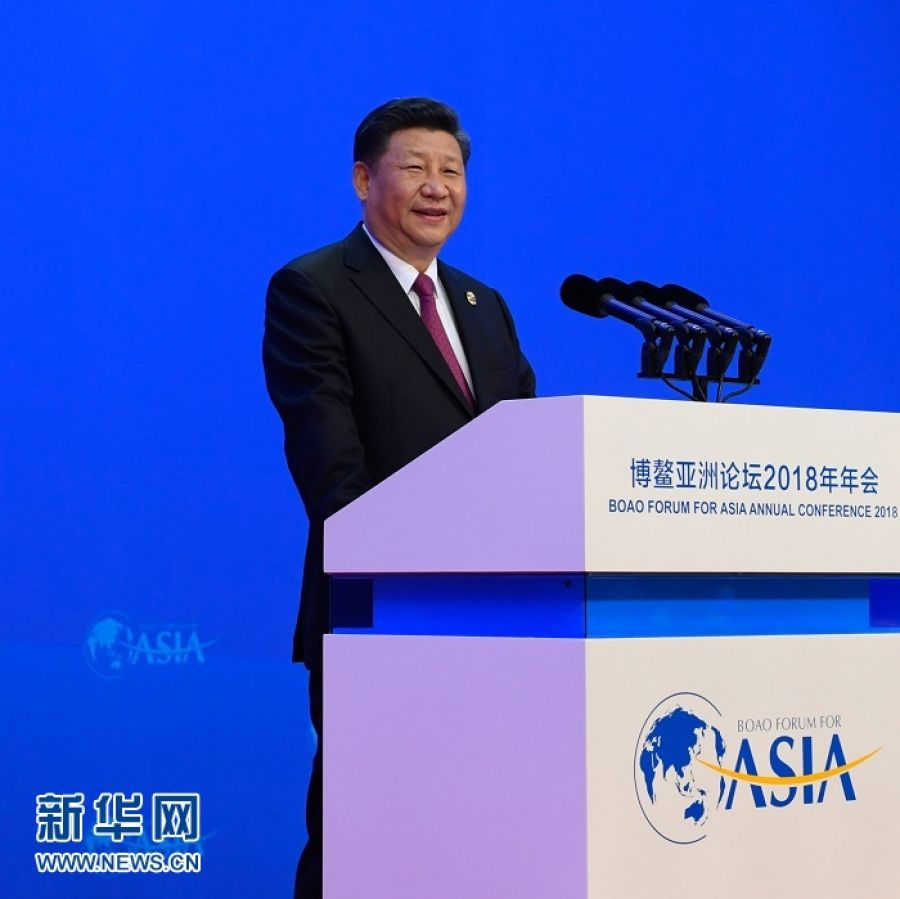
On 10 April the Boao Forum for Asia Annual Conference 2018 opened in Boao, Hainan Province. President Xi Jinping put forward a series of new measures for China’s opening-up, including the proactive expansion of imports. President Xi stressed that the first China International Import Expo will be held in Shanghai this November: this is a big platform — not an ordinary exhibition, but a major policy declaration and action by which China proactively opens its market. Friends from all countries are welcome to come to China to take part. President Xi announced that this year China will considerably lower import tariffs on automobiles while also reducing import tariffs on some other products, strive to increase imports of distinctive and advantageous products for which public demand is relatively concentrated, and accelerate the process of joining the WTO Agreement on Government Procurement.
On 10 April the Boao Forum for Asia Annual Conference 2018 opened in Boao, Hainan Province. President Xi Jinping put forward a series of new measures for China’s opening-up, including the proactive expansion of imports. President Xi stressed that the first China International Import Expo will be held in Shanghai this November: this is a big platform — not an ordinary exhibition, but a major policy declaration and action by which China proactively opens its market. Friends from all countries are welcome to come to China to take part. President Xi announced that this year China will considerably lower import tariffs on automobiles while also reducing import tariffs on some other products, strive to increase imports of distinctive and advantageous products for which public demand is relatively concentrated, and accelerate the process of joining the WTO Agreement on Government Procurement.
In this regard, E Zhihuan, chief economist of Bank of China (Hong Kong), believes that “China’s promotion of imports and of balanced trade development is of great significance for building a modern economic system.” On the one hand, promoting imports can achieve balanced development of foreign trade, better meet the growing domestic consumer demand, improve the quality of life of Chinese residents and enhance the people’s sense of gain; on the other hand, increasing imports can bring competitive pressure to bear on the relevant domestic industries, allowing the fittest to survive, which can push Chinese enterprises to improve product quality and strengthen innovative development, ultimately promoting domestic industrial upgrading. Finally, lowering tariffs can provide domestic consumers with more quality choices and thus meet the people’s needs for a better life.
Huang Zhilong, director of the Macroeconomic Research Centre of the Suning Institute of Finance, said that China’s promotion of imports and of trade balance is significant in at least three major respects: first, for the Chinese economy, expanding imports is more conducive to fully using the products and resources of other countries, improving the efficiency of market-based resource allocation and improving national welfare; second, for the world economy, promoting imports will help raise the contribution of the Chinese economy to global growth, especially by further increasing China’s contribution on the demand side; and finally, a trade balance is conducive both to a balanced balance of payments and to the stability of the renminbi exchange rate.
In fact, this year’s government work report proposed expanding opening-up in telecommunications, healthcare, education, elderly care and other fields and lowering import tariffs on automobiles and some consumer goods. E Zhihuan believes that choosing to expand imports in telecommunications, healthcare, education, elderly care and other fields can, on the one hand, enrich domestic market supply and reduce consumption costs and, on the other hand, encourage domestic enterprises, through openness to imports, to align more directly with international standards and draw on international experience, thereby raising the level and competitiveness of the domestic service industry.