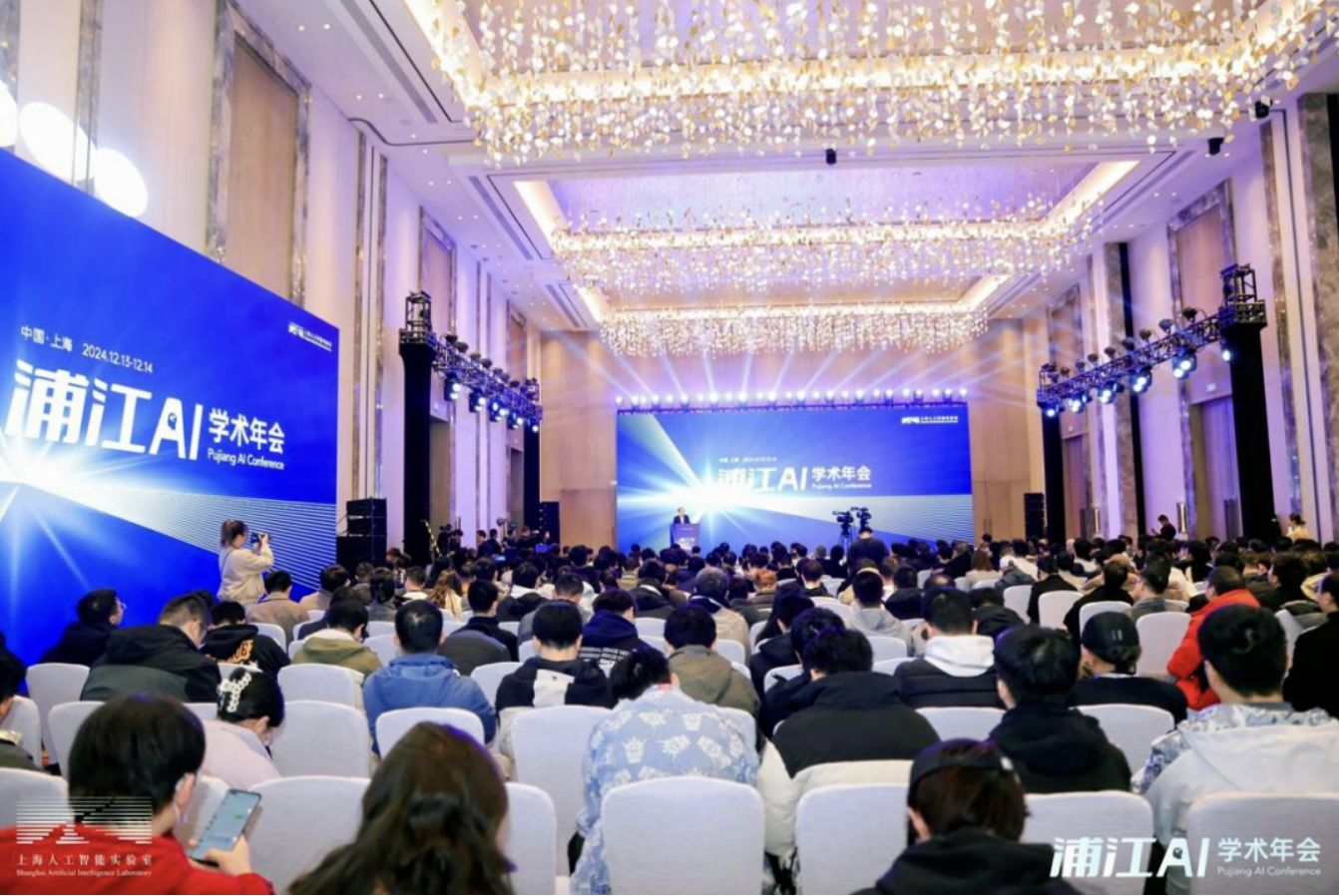
On the morning of December 13, 2024, the first “Pujiang AI Academic Annual Conference”, initiated and hosted by Shanghai Artificial Intelligence Laboratory, was successfully convened. Liu Duo, Deputy Mayor of Shanghai, and Li Meng, Chairman of the China Society for Sustainable Development, member of the 14th National Committee of the CPPCC and former Vice Minister of Science and Technology, attended the meeting.
The Pujiang AI Academic Annual Conference (hereinafter the “Annual Conference”) is co-chaired by Andrew Chi-Chih Yao, Dean of the Institute for Interdisciplinary Information Sciences and Dean of the College of AI at Tsinghua University and Dean of the Shanghai Qi Zhi Institute, and Zhou Bowen, Director and Chief Scientist of Shanghai AI Laboratory and Huiyan Chair Professor at Tsinghua University.
Reposted from Shanghai Science and Technology
On the morning of December 13, 2024, the first “Pujiang AI Academic Annual Conference”, initiated and hosted by Shanghai Artificial Intelligence Laboratory, was successfully convened. Liu Duo, Deputy Mayor of Shanghai, and Li Meng, Chairman of the China Society for Sustainable Development, member of the 14th National Committee of the CPPCC and former Vice Minister of Science and Technology, attended the meeting.
The Pujiang AI Academic Annual Conference (hereinafter the “Annual Conference”) is co-chaired by Andrew Chi-Chih Yao, Dean of the Institute for Interdisciplinary Information Sciences and Dean of the College of AI at Tsinghua University and Dean of the Shanghai Qi Zhi Institute, and Zhou Bowen, Director and Chief Scientist of Shanghai AI Laboratory and Huiyan Chair Professor at Tsinghua University.
During the two-day Annual Conference, top experts, scholars and industry leaders in the global AI field gathered together; more than 150 AI experts and scholars from around the world held in-depth discussions on important topics such as frontier AI development trends, key technical challenges, innovative collaboration mechanisms and industrial application practices, in the plenary forum and 10 thematic forums. The Annual Conference attracted more than 3,000 registered on-site participants.
Building an innovation and collaboration platform and playing the role of connector, amplifier and accelerator
The opening ceremony was moderated by Professor Qiao Yu, Assistant Director and Leading Scientist of Shanghai AI Laboratory.
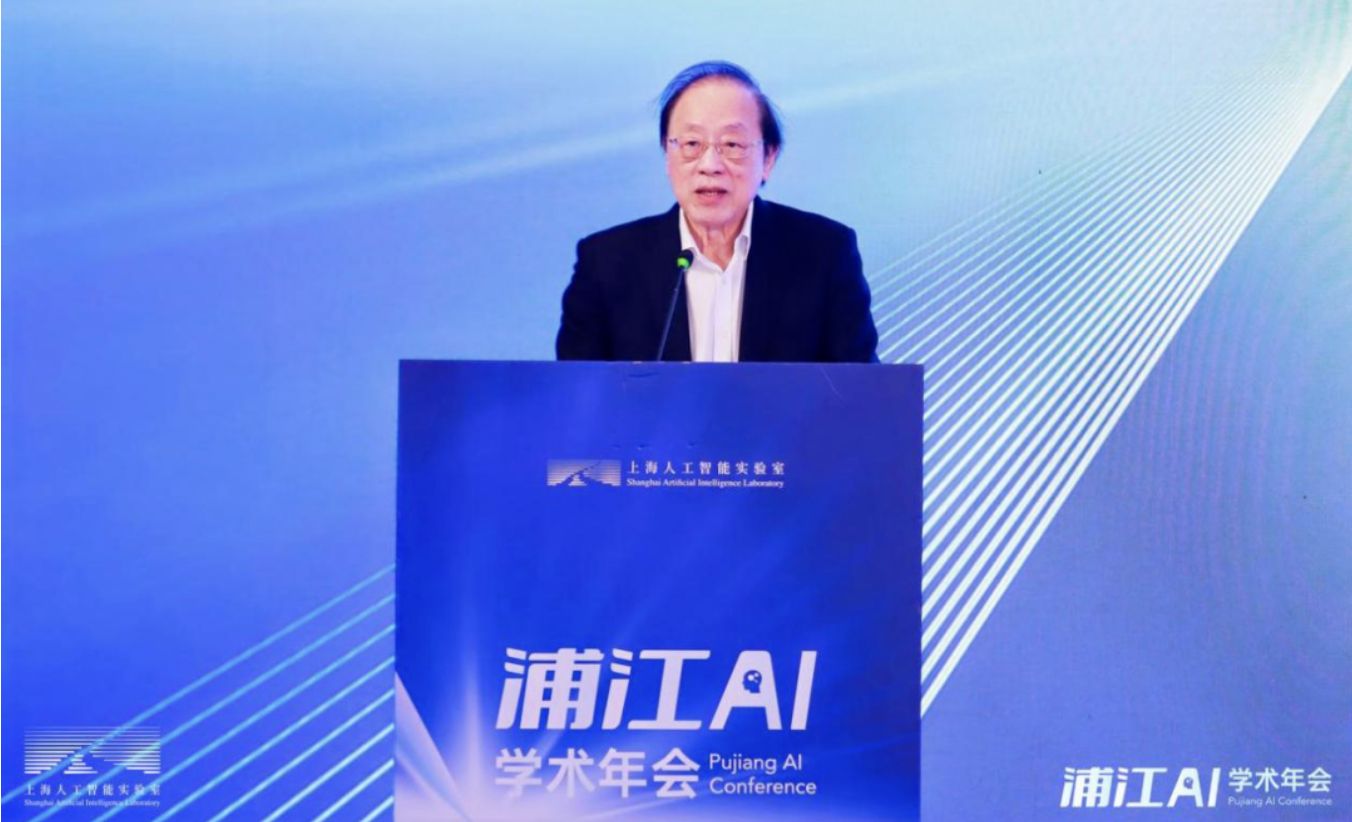
Andrew Chi-Chih Yao, Dean of the Institute for Interdisciplinary Information Sciences and Dean of the College of AI at Tsinghua University and Dean of the Shanghai Qi Zhi Institute
In his speech, Yao noted that artificial intelligence is the strategic technology that leads the future, and that talent introduction and cultivation are key to the success of scientific research. China has already made remarkable progress in introducing and cultivating high-end talent, especially in the innovative achievements of doctoral students and young scientists, reaching advanced international levels. He stressed that in addition to attracting talent, it is also necessary to offer opportunities for long-term development and to cultivate first-class research teams.
The laboratory’s original intention in holding the “Pujiang AI Academic Annual Conference” is to use the conference as a vehicle to promote in-depth “problem-oriented” academic discussion, to inspire more innovative ideas through high-quality questions, to “pose good questions to one another and collaborate with one another”, and to achieve industrial cooperation and collaborative innovation at a higher level.
Zhou Bowen, Director and Chief Scientist of Shanghai AI Laboratory and Huiyan Chair Professor at Tsinghua University
Zhou Bowen believes that everyone is now focusing on “Scaling Law”, and what will be “Scaling What” next? Discussions cover the scaling of computing power and data and, most recently, of inference time. He suggested that equally important is how to raise the “Scale” of researchers. Citing the contrast between the team sizes of early atomic physics research and those of the recent particle discoveries, Zhou said: “Because the research of any single team is limited, how can we creatively unleash the creativity of the team itself while better completing collaboration between teams and achieving a higher-level Scale? I think this is a question that also needs to be studied in the next stage of Scaling Law, and a question we should raise with greater foresight.”
Zhou Bowen told the guests that Shanghai Artificial Intelligence Laboratory has always been thinking about three major questions — frontier development trends, key technical challenges and innovative cooperation mechanisms — which are reflected respectively in the building and development of three core capabilities: advanced AI technology, safety and trustworthiness assurance, and industrial ecosystem collaboration.
“Shanghai Artificial Intelligence Laboratory is willing, with an open and proactively embracing attitude, not to compete with universities for reputation or with enterprises for profit, but to collaborate with all colleagues. The laboratory is willing to serve as a platform and to become everyone’s connector, amplifier and accelerator, so that these capabilities can be brought into fuller play through innovative collaboration mechanisms and win-win results can be achieved,” Zhou Bowen said, adding that progress in artificial intelligence depends not only on individual efforts but even more on the convergence of collective strength.
Zhou Bowen further elaborated on the “three devices” positioning of Shanghai AI Laboratory:
-
Connector: the laboratory will assist outstanding researchers and teams in organizing single-point innovations into systems that can deliver higher value; by coordinating resources from multiple parties, it precisely guides and gathers innovation points, ensuring that each innovation point can deliver maximum effectiveness within the system and driving overall technological breakthroughs.
-
Amplifier: the laboratory will help outstanding researchers and teams take part in solving the most challenging and influential major problems and advance causes of far-reaching significance; by undertaking high-value tasks and amplifying the value of technology in the process, it drives technology toward a higher level.
-
Accelerator: the laboratory will support outstanding researchers and teams in rapidly realizing the industrial value and development potential of technology; by accelerating the validation and application of technological achievements, it promotes the rapid deployment of technology in industry and helps technology generate real economic and social benefits.
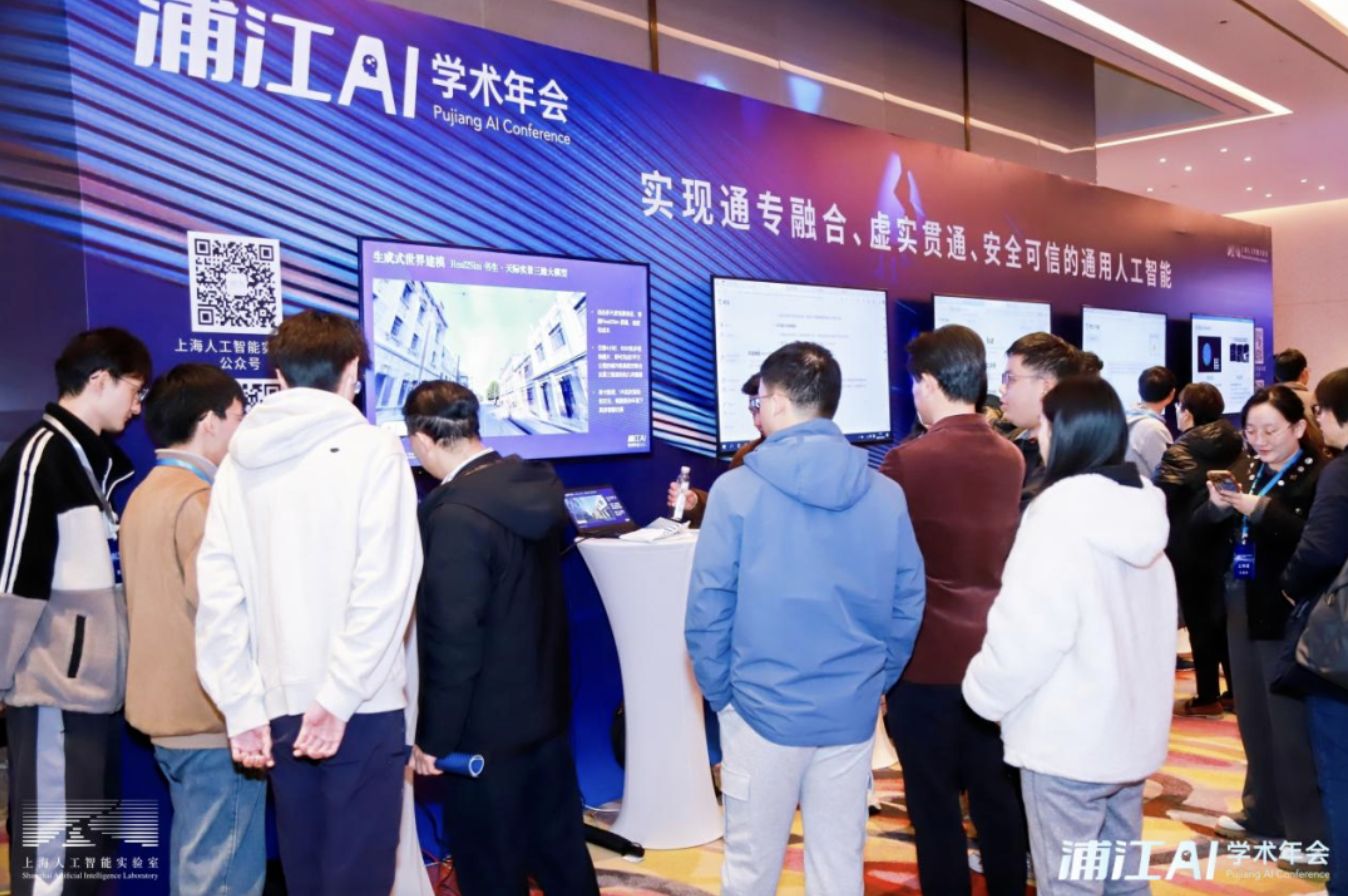
At the venue of the Pujiang AI Academic Annual Conference, the InternLM large model, the InternVL multimodal large model, the latest strong-reasoning model InternThinker and posters of NeurIPS 2024 papers were on display, drawing visitors to stop and study them.
Source: Shanghai Artificial Intelligence Laboratory
Editor: Shi