The Lingang New Area of the Shanghai Free Trade Zone was officially unveiled on the 20th. The establishment of the new area highlights China’s resolve to hold high the banner of opening up, and will bring new dividends for economic development in areas such as taxation and talent.
2019-08-20 17:44:14 Source: Xinhua Net
He Xinrong, Sang Tong and Yang Youzong, Xinhua “Xinhua Viewpoint” reporters
The Lingang New Area of the Shanghai Free Trade Zone was officially unveiled on the 20th. The establishment of the new area highlights China’s resolve to hold high the banner of opening up, and will bring new dividends for economic development in areas such as taxation and talent.
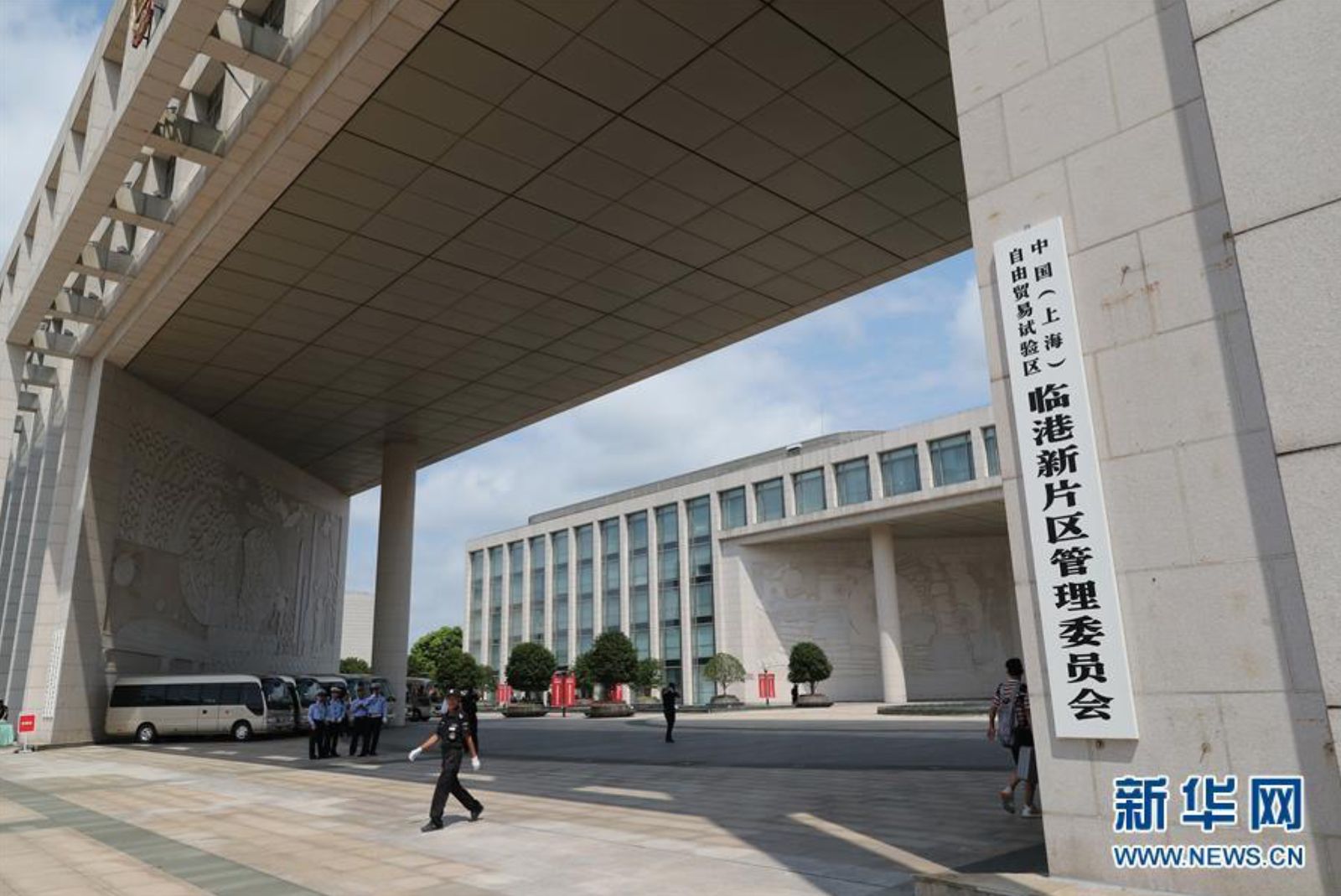
This is an exterior view of the Management Committee of the Lingang New Area of the China (Shanghai) Pilot Free Trade Zone, photographed on 20 August. Xinhua reporter Fang Zhe.
[Dividend 1] The new area is managed by reference to special economic zones, leaving more room for law-based reform
The Overall Plan for the Lingang New Area of the China (Shanghai) Pilot Free Trade Zone issued by the State Council proposes that the new area be managed by reference to special economic zones. All reform and opening-up measures in the area that involve adjusting existing laws or administrative regulations shall be implemented after unified authorization by the National People’s Congress or the State Council in accordance with statutory procedures.
Management by reference to special economic zones means that the new area is not a simple expansion: the focus is on exploring experience in key fields that demand a high degree of openness but where other regions do not yet have the conditions for implementation, and on establishing an institutional system aligned with internationally accepted rules.
Zhong Shan, Minister of Commerce, said at the unveiling ceremony that adding the Lingang New Area to the Shanghai Pilot Free Trade Zone is a major strategic arrangement made by the Party Central Committee with Comrade Xi Jinping at its core, and is of great and far-reaching significance for promoting reform and opening up in the new era and advancing the integrated development of the Yangtze River Delta. It also demonstrates China’s firm determination and confidence in promoting all-round opening up and building an open world economy.
Zhang Yong, a researcher at the Shanghai Free Trade Zone Comprehensive Research Institute of Fudan University, said it can be foreseen that the next institutional innovations concerning the new area will provide legal guarantees for its construction, enabling it to “venture boldly, experiment boldly and reform on its own initiative”.
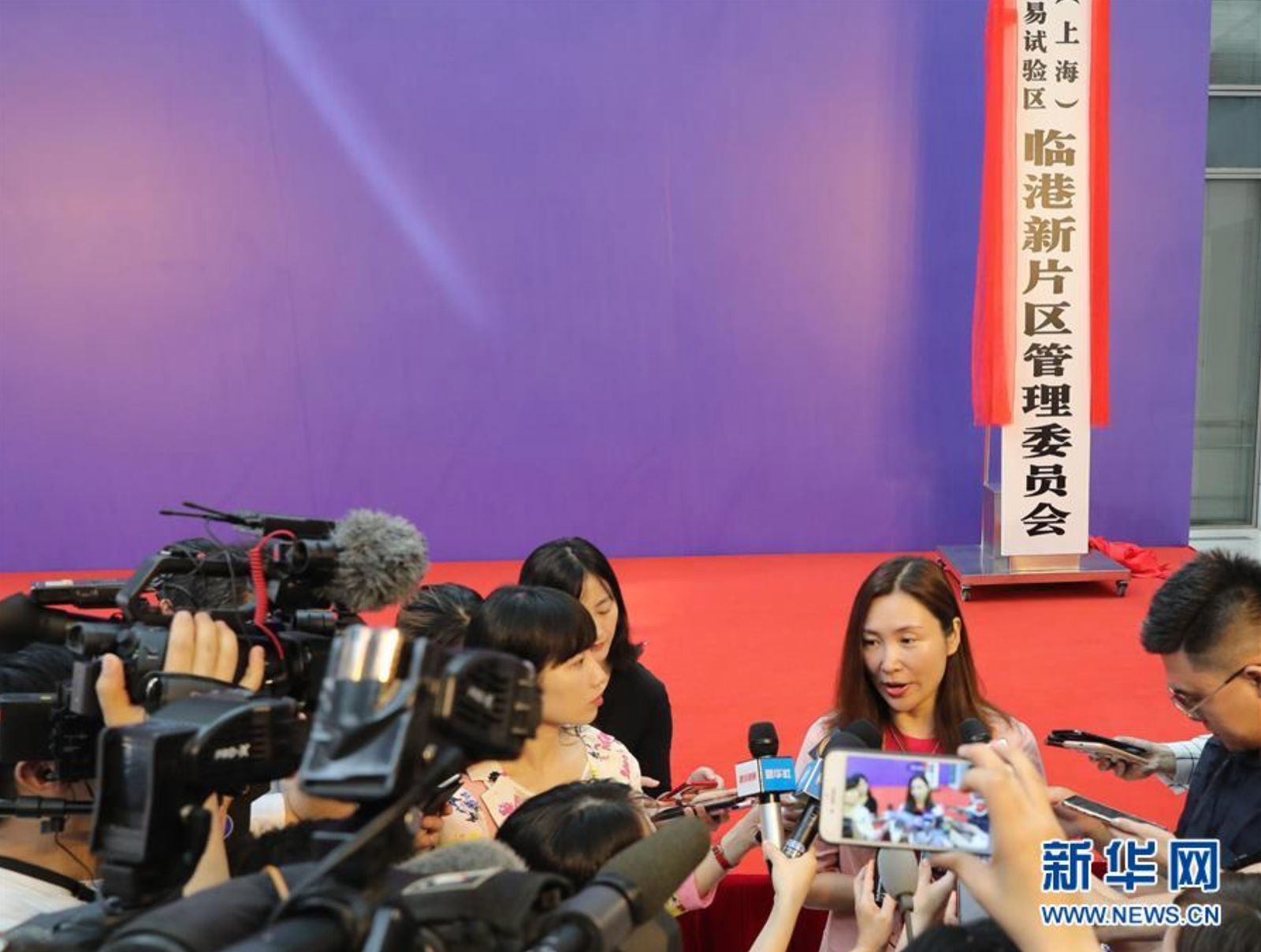
On 20 August, an enterprise representative (second from right) is interviewed by the media after the unveiling ceremony. Xinhua reporter Fang Zhe.
[Dividend 2] The “five freedoms” are clearly targeted: companies and residents enjoy the convenience of free capital flows
The Overall Plan makes clear that the Lingang New Area of the Shanghai Free Trade Zone should focus on freedom of investment, trade, capital, transport and employment, and build a special economic function zone with greater influence and competitiveness on the international market.
The shift from the “facilitation” of the past to today’s “five freedoms” is seen by industry insiders as a major highlight of the plan.
What new changes will the “five freedoms” bring? The enthusiasm of financial institutions gives a good indication. On the 20th, the Bank of China Shanghai Branch announced the launch of the first batch of inclusive finance loans in the new area of the free trade zone, providing three small and micro enterprises in the area with a total of 8 million yuan in credit and related dedicated comprehensive financial services. Earlier, the Lingang New Area branch of China Construction Bank’s Shanghai Free Trade Zone branch and the Lingang New Area branch of Bank of China’s Shanghai Free Trade Zone branch had both been unveiled, becoming the first financial institutions to set up branches in the new area.
At the unveiling ceremony on the 20th, Shanghai Lingang New Area Economic Development Co., Ltd., wholly owned by Shanghai Lingang Group, received business licence No. 001 for the new area, with registered capital of 2 billion yuan in the first phase. Lingang Group said it will lose no time in building the relevant functional zones of the Lingang New Area, and is committed to forming the basic framework of a modern economic system in the new area centred on the innovation economy, headquarters economy, digital economy and offshore economy.
Tang Jianwei, chief researcher at the Bank of Communications Financial Research Centre, said that in the future the new area is expected to make fresh progress in promoting the free flow and exchange of capital through free trade accounts. For example, individuals would be allowed to conduct outward portfolio investment through free trade accounts, breaking through the channel-based opening restrictions of schemes such as Shanghai-Hong Kong Stock Connect.
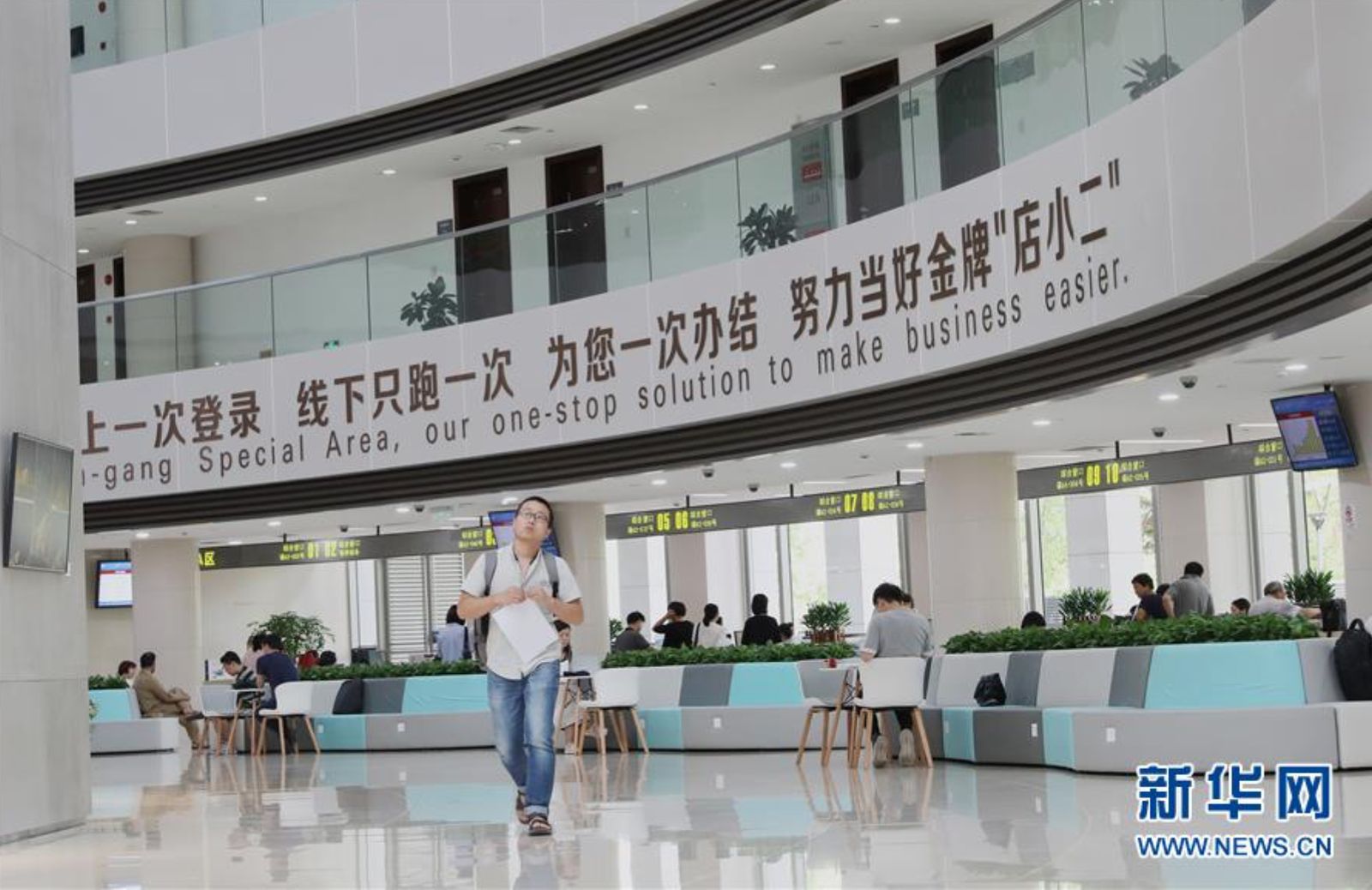
This is an interior view of the Administrative Service Centre of the Lingang New Area of the China (Shanghai) Pilot Free Trade Zone, photographed on 20 August. Xinhua reporter Fang Zhe.
[Dividend 3] Special tax arrangements for offshore business to attract headquarters institutions
The Overall Plan proposes building an Asia-Pacific supply chain management centre in the new area, improving the systematic institutional support system for new types of international trade and for investment and financing services on the international market, and attracting headquarters-type institutions to cluster there. The scope of the value-added tax policy for service exports will be expanded in the new area, and tax policies suited to the development of outbound investment and offshore business will be studied.
What is offshore business? For example, a multinational company buys raw materials in Thailand, sends them to Vietnam for processing and finally sells the products in Japan. None of the logistics passes through Shanghai, yet the contracts and orders, payments, insurance and trade financing are all arranged through Shanghai — thus occupying the high ground of the industrial and supply chains.
Previously, because China lacked special tax arrangements for activities such as offshore trade, some multinational companies conducted a large volume of import and export trade in China while keeping higher value-added headquarters functions such as financing and settlement abroad, thereby losing a considerable amount of employment and tax revenue.
Song Penglin, deputy director of the Comprehensive Reform Division of the Shanghai Municipal Development and Reform Commission, said that free trade zones around the world generally apply special “inside the border, outside the customs territory” policies that differ from those of other parts of the country. The core of these “special policies” is a tax policy featuring a low tax burden, the aim being to put companies in the zone on the same starting line as overseas companies in international market cooperation and competition and to expand the increment of international business.
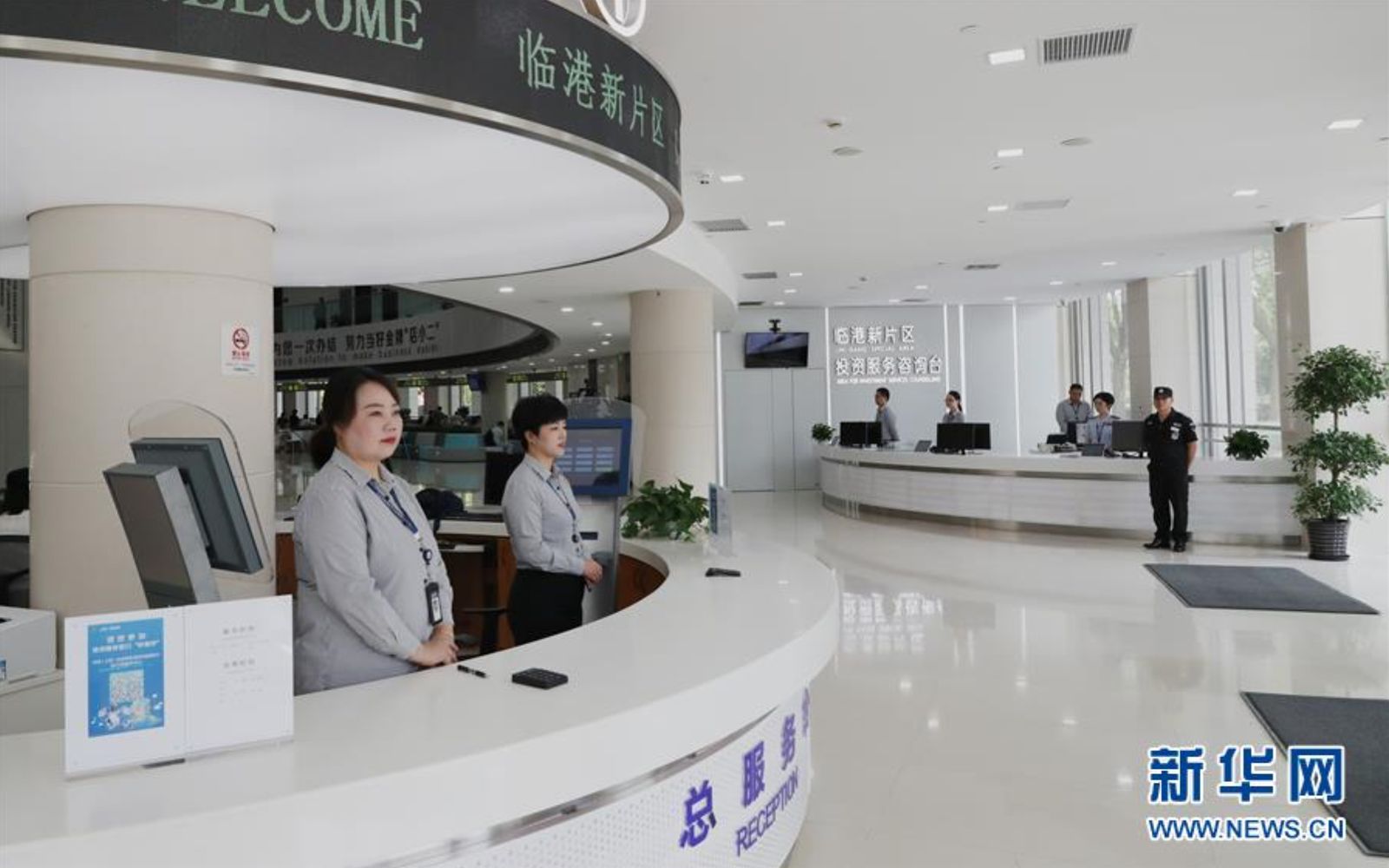
This is an interior view of the Administrative Service Centre of the Lingang New Area of the China (Shanghai) Pilot Free Trade Zone, photographed on 20 August. Xinhua reporter Fang Zhe.
[Dividend 4] A 15% income tax rate benefits high-tech manufacturing; “hard technology” is favoured
Under the Overall Plan, the new area will build an open industrial system with international market competitiveness. For qualified enterprises in the new area engaged in the production and R&D of core links in key fields such as integrated circuits, artificial intelligence, biomedicine and civil aviation, corporate income tax will be levied at a reduced rate of 15% for five years from the date of establishment.
Qiu Ciyun, CEO of Shanghai Xinsheng Semiconductor Technology Co., Ltd., which makes large silicon wafers for integrated circuits, said at the unveiling ceremony: “The preferential policies of the new area on talent and taxation are very important to high-tech manufacturing companies like ours.”
Tesla’s Shanghai Gigafactory, previously established in Lingang, has also recently seen new progress. On the 19th, the Lingang Tesla Gigafactory project (phase one) successfully obtained its first comprehensive acceptance certificate — the comprehensive acceptance certificate for the power station building — further accelerating the pace of Tesla’s official start of production.
“In just a few months, the plant construction, equipment entry, installation and commissioning were completed — a completely new attempt for both Tesla and Shanghai. We plan to roll out vehicles by the end of the year,” said Tao Lin, Tesla’s global vice president.
Hu Yijian, dean of the Institute of Public Policy and Governance at Shanghai University of Finance and Economics, said that levying corporate income tax at a reduced rate of 15% is not unique to the Lingang New Area: it also applies in free trade zones such as Hengqin in Zhuhai, Guangdong, and Qianhai in Shenzhen, though the fields covered differ. This time the Lingang New Area focuses on frontier industrial clusters such as integrated circuits, artificial intelligence and biomedicine, which will help speed up the development of advanced manufacturing clusters.
[Dividend 5] Adjustments to entry and exit, household registration and home purchase policies to attract global talent
Popularity is crucial to a region’s development. Under the Overall Plan, the new area will implement free and convenient personnel management. Restrictions on high-end talent in modern service industries will be relaxed, and more open and convenient policies and measures will be implemented for personnel entry and exit and for permanent residence of foreign talent.
A relevant official of Shanghai said earlier that, to create a more attractive environment for talent, the period for “converting residence permits into household registration” for talent in the new area has been shortened from seven years to five, and to three years for core talent. For talent without local household registration, eligibility to buy housing has been adjusted from the household to the individual.
Yan Yuejin, research director of the Think Tank Centre of the E-House Research Institute, believes the new area’s property market policy should be viewed rationally. “The purpose of adjusting the policy is to improve the environment for talent development; this is what is needed to enhance the competitiveness of high-end industries in the free trade zone. In implementation, the principle that ‘houses are for living in, not for speculation’ must still be upheld.”
[Dividend 6] Funds raised in the area used outside it: coordinated development with the Yangtze River Delta
The Overall Plan proposes that the new area strengthen coordinated innovation and development with the Yangtze River Delta. Domestic and overseas investors will be supported in setting up joint innovation special funds in the new area and in cooperating on major scientific research projects, and the relevant funds may be used freely in the Yangtze River Delta region.
Vice Minister of Commerce Wang Shouwen said earlier that, building on the other areas of the Shanghai Free Trade Zone, which actively serve the Belt and Road Initiative and the development of the Yangtze River Economic Belt, the Lingang New Area further emphasizes serving and integrating into the national strategy of integrated development of the Yangtze River Delta, adding content such as “strengthening coordinated innovation and development with the Yangtze River Delta” and “driving a new round of reform and opening up in the Yangtze River Delta”, which enriches its strategic tasks.