Why Shanghai? Why a science and technology innovation center?
Eleven years ago, as soon as General Secretary Xi Jinping put forward the requirement for Shanghai to “speed up its march toward a science and technology innovation center with global influence”, people began to ponder the deeper meaning behind it.
Eleven years later, in April 2025, the General Secretary inspected Shanghai and further stressed that Shanghai bears the historic mission of building an international science and technology innovation center, and should seize opportunities, take serving the national strategy as the guide, continuously enhance the source function of scientific and technological innovation and the leading function of high-end industries, and accelerate the building of a science and technology innovation highland with global influence.
Why Shanghai? Why a science and technology innovation center?
Reprinted from Shanghai Science and Technology, July 7, 2025
Eleven years ago, as soon as General Secretary Xi Jinping put forward the requirement for Shanghai to “speed up its march toward a science and technology innovation center with global influence”, people began to ponder the deeper meaning behind it.
Eleven years later, in April 2025, the General Secretary inspected Shanghai and further stressed that Shanghai bears the historic mission of building an international science and technology innovation center, and should seize opportunities, take serving the national strategy as the guide, continuously enhance the source function of scientific and technological innovation and the leading function of high-end industries, and accelerate the building of a science and technology innovation highland with global influence.
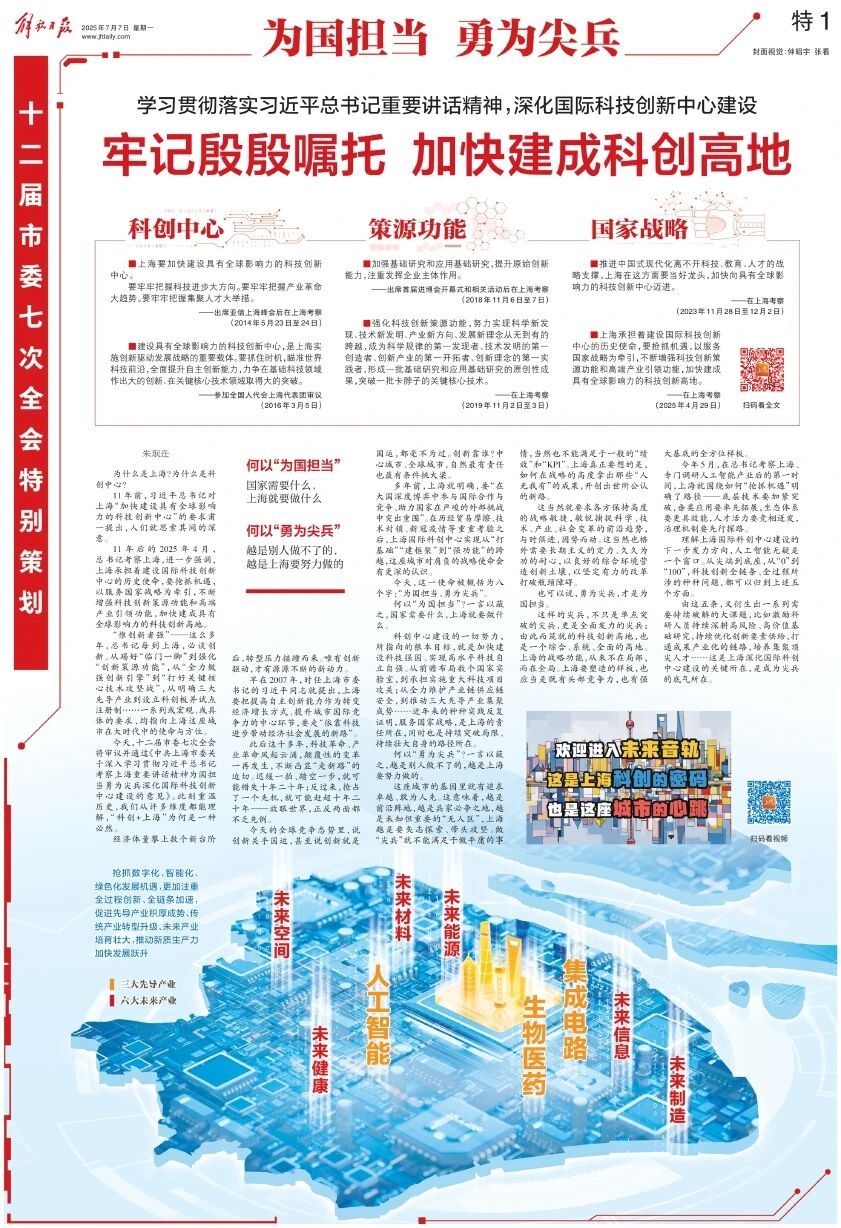
“Only innovators are strong” — for so many years, whenever the General Secretary visited Shanghai, he always talked about innovation. From “scoring the final goal” to strengthening the “source function of innovation”, from “doing everything to strengthen the innovation engine” to “winning the battle for key core technologies”, from defining the three leading industries to establishing the STAR Market and piloting the registration-based IPO system… a series of requirements, some macro and some specific, all point to this city’s mission and position in a great era.
Today, the Seventh Plenary Session of the 12th Municipal Party Committee will deliberate and adopt the “Opinions of the CPC Shanghai Municipal Committee on Thoroughly Studying and Implementing the Spirit of General Secretary Xi Jinping’s Important Speech during His Inspection of Shanghai, Shouldering Responsibility for the Country, Being a Pioneer, and Deepening the Building of the International Science and Technology Innovation Center”. As we review history at this moment, we can understand from many dimensions why “sci-tech innovation + Shanghai” is an inevitability.
After the economy climbed several new steps, the path of factor-driven growth has grown narrower and narrower, and the pressure to transform has followed close behind. Only innovation-driven development can provide an inexhaustible new momentum.
As early as 2007, Comrade Xi Jinping, then Secretary of the Shanghai Municipal Party Committee, proposed that Shanghai should make enhancing its independent innovation capacity the central link in transforming its economic growth model and raising the city’s international competitiveness, and should take “a new path of driving economic and social development through scientific and technological progress”.
In the decade and more since then, scientific and technological revolutions and industrial revolutions have surged, disruptive changes have occurred again and again, and the importance and urgency of “taking the new path” have been constantly highlighted. Sometimes, being one beat slow or missing one step can mean losing ten or twenty years. Conversely, seizing one opportunity early can mean catching up by ten or twenty years — looking around the world, there are examples of both. Shanghai certainly knows that “without innovation, there is no future”.
For a country, this is even more true. In today’s global competition, it is no exaggeration to say that innovation bears on the fate of the nation — or even that innovation is the fate of the nation. Who should innovate? Central cities and global cities naturally bear the greatest responsibility and are best placed to take the lead.
Years ago, Shanghai made it clear that it would “participate in international cooperation and competition amid the deep game among major powers, and help the country break out of a tight encirclement of severe external challenges”. After weathering repeated tests such as trade frictions, technology blockades and the COVID-19 pandemic, the Shanghai International Science and Technology Innovation Center has leapt from “laying the foundation” and “building the framework” to “strengthening its functions”, and the city has come to a deeper understanding of the strategic mission it bears.
Today, that mission is summed up in eight characters: “shoulder responsibility for the country and be a pioneer”.
What does “shouldering responsibility for the country” mean? In a word: whatever the country needs, Shanghai will do.
The fundamental goal of all efforts to build the science and technology innovation center is to speed up the building of a science and technology powerhouse and achieve high-level scientific and technological self-reliance and self-strengthening. From the forward-looking establishment of several national laboratories to undertaking and implementing major science and technology projects; from doing everything to safeguard the security of industrial and supply chains to promoting the clustering and growth of the three leading industries… practice in recent years has repeatedly proved that serving the national strategy is where Shanghai’s responsibility lies, and also the path by which it continues to break through limitations and grow stronger.
What does “being a pioneer” mean? In a word: the more something is beyond others’ reach, the more Shanghai must strive to do it.
This city’s innate DNA includes the pursuit of excellence and the courage to be first. This means that the more a field is at the frontier, the more it is contested terrain, the more it is an unknown but important “no man’s land”, the more Shanghai must be determined to explore and take the lead in breaking through. A “pioneer” cannot be content with doing mediocre things, and certainly cannot be content with ordinary “performance” and “KPIs”. What Shanghai should really be thinking about is how, at a strategic level, to produce results that “others do not have” and open up new paths recognized by the world, so as to truly stand at the crest of the wave.
This of course requires all parties to maintain a high degree of strategic agility, keenly capture the frontier trends of changes in science, technology, industry and society, keep pace with the times and act according to the situation. On many key issues — such as breakthroughs in core technologies, the connection of the innovation chain with the industrial chain, and ecosystem cultivation — there is a particular need for the resolve of long-termism and the patience to work steadily over the long haul, to create fertile soil for innovation through a sound comprehensive environment, and to break bottlenecks and obstacles through firm and effective reform.
In other words, being a pioneer is precisely what it means to shoulder responsibility for the country.
And such a pioneer is not only one that achieves breakthroughs at single points, but one that brings its strength to bear across the board; the science and technology innovation highland thus built is likewise a comprehensive, systemic and all-round highland.
Shanghai’s strategic function has never been local, but overall. The model Shanghai should create should also be an all-round model with both leading competitiveness and a strong foundation.This is crucial whether one is understanding a specific area of breakthrough, the overall building of the science and technology innovation center, or even the modernization of the entire city.
In May this year, immediately after the General Secretary’s inspection of Shanghai and his special research on the artificial intelligence industry, Shanghai defined five guidelines on how to “seize opportunities” — break through underlying technologies with greater urgency, take the lead in expanding vertical applications, make the ecosystem more efficient, let the vitality of talent burst forth, and pioneer new paths in governance mechanisms.
To understand where the building of the Shanghai International Science and Technology Innovation Center will focus next, artificial intelligence is undoubtedly a window. From the cutting edge to the foundation, from “0” to “100”, all kinds of issues involved in the entire chain and process of scientific and technological innovation can be traced back to the five guidelines above.
From these five guidelines derive a series of major issues that need to be continuously addressed, such as motivating researchers to keep delving into high-risk, high-value basic research, continuously optimizing the supply of innovation factors, connecting the chain of industrializing results, and cultivating and gathering top talent… This is the key to Shanghai’s deepening of the building of the international science and technology innovation center, and also the source of its confidence in becoming a “pioneer”.
And all of this can be traced back to the starting point eleven years ago, when the “science and technology innovation center” was first called for.
How to become “a science and technology innovation center with global influence”? It is worth recalling the General Secretary’s three statements at that time —
Firmly grasp the general direction of scientific and technological progress,
Firmly grasp the general trend of the industrial revolution,
Firmly grasp the major move of gathering talent.
Source: Jiefang Daily
Author: Zhu Minwu