A national financial centre and transport hub, its port is the busiest in the world; its main industries include commerce and distribution, finance, information and manufacturing. Shanghai lies at the very centre of China’s arc-shaped eastern coastline, at the easternmost end of the Yangtze River Delta; it faces the East China Sea to the east, Hangzhou Bay to the south and the provinces of Jiangsu and Zhejiang to the west, while Chongming Island at its northern tip sits in the mouth of the Yangtze. The Shanghai Municipality is one of the largest cities in the world: as of 2016 its resident population stood at 24.197 million, of whom 59% — 14.395 million — held a local household registration. In recent years Shanghai has also joined with a number of fast-growing cities in neighbouring Jiangsu and Zhejiang to form the Yangtze River Delta urban agglomeration, one of the world’s major urban agglomerations.
Shanghai Municipality — abbreviated as Hu and also known as Shen — is a municipality directly under the Central Government of the People’s Republic of China, a national financial centre and transport hub whose port is the busiest in the world; its main industries include commerce and distribution, finance, information and manufacturing. Shanghai lies at the very centre of China’s arc-shaped eastern coastline, at the easternmost end of the Yangtze River Delta; it faces the East China Sea to the east, Hangzhou Bay to the south and the provinces of Jiangsu and Zhejiang to the west, while Chongming Island at its northern tip sits in the mouth of the Yangtze. The Shanghai Municipality is one of the largest cities in the world: as of 2016 its resident population stood at 24.197 million, of whom 59% — 14.395 million — held a local household registration. In recent years Shanghai has also joined with a number of fast-growing cities in neighbouring Jiangsu and Zhejiang to form the Yangtze River Delta urban agglomeration, one of the world’s major urban agglomerations.
After the founding of the People’s Republic of China, the central government ran a planned economy and focused on developing heavy industry in the interior and other regions; Western countries also imposed an economic blockade on the People’s Republic, and Shanghai gave extensive support to the development of other parts of mainland China. After the launch of reform and opening up, Shanghai was granted the Pudong development and opening policy in 1990 and its economic growth accelerated; the National Comprehensive Supporting Reform Pilot Zone set up in 2005 and the Shanghai Free Trade Zone approved in 2013 further advanced its economy, turning the city into a world-class metropolis and the economic, financial and trade centre of mainland China and a pillar of its fiscal revenue — although at the same time it faces problems such as crime committed by people from other regions who come to Shanghai, and the erosion of the Shanghainese dialect and of Shanghai-style culture.
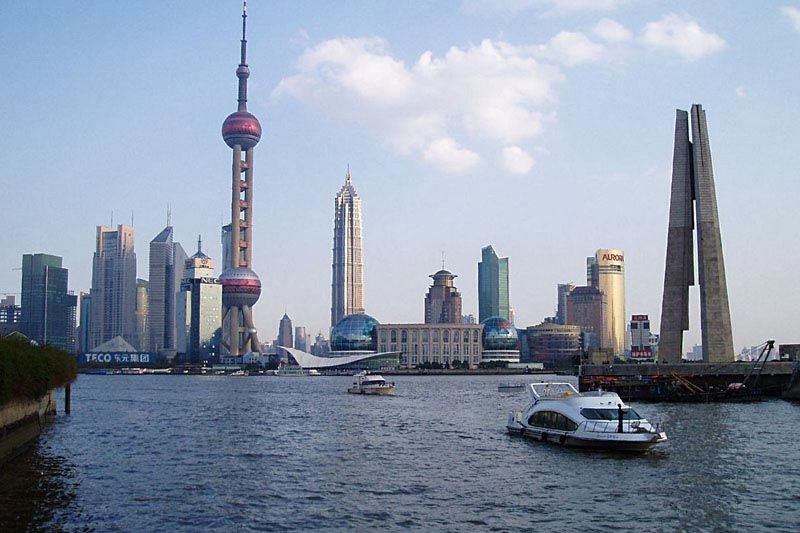
Shanghai is an exemplar of China’s modern and contemporary economic development, and it therefore also boasts many famous landmarks, including the Yu Garden and City God Temple, Nanjing Road and the Bund, and the Lujiazui skyscraper skyline.