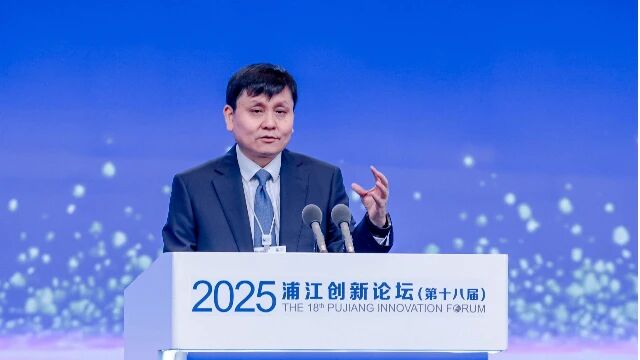
“We must not let scientific work stop at papers; we must make it land and reach every corner of the globe. We must not only cross mountains and seas, but also bridge the gap between science and technology and communication, and ultimately break the global imbalance in health and eliminate health inequities,” said Zhang Wenhong, director of the National Medical Center for Infectious Diseases (Shanghai), director of the Department of Infectious Diseases at Huashan Hospital affiliated with Fudan University, and director of the Shanghai Center for Science and Technology Innovation in Infection and Immunity.
He made this appeal on September 22 in his opening address at the “Future Health: Global Health and Development Forum” (hereinafter “the Forum”) of the 2025 Pujiang Innovation Forum. At the Forum, the Global Health Innovation Institute announced its official launch; it is China’s first new-type research, development and translation institution with global health as its mission.
The Global Health Innovation Institute focuses mainly on advancing the translation stage in which health products geared to the needs of low- and middle-income countries move from the laboratory to the market. Gong Wenfeng, deputy director of the Gates Foundation Beijing Representative Office, told a Yicai reporter that this stage often involves large funding needs and high risks, so both governments and enterprises are now attaching increasing importance to investment in and support for product translation.
He added that the institute focuses not only on promoting product development but, more importantly, on pooling resources: it works to connect China’s original R&D and production capacity and to integrate international clinical and field validation resources, and such international cooperation is crucial to advancing global health products.
The institute’s R&D funding for its first five years is provided jointly by Shanghai and the Gates Foundation, with the Gates Foundation providing project grants and technical support and Shanghai providing corresponding funding and resources.
From translation to real-world application
Zhang Wenhong said the world still faces enormous challenges from infectious diseases such as tuberculosis and malaria, and the core task at present is to ensure that scientific and technological innovations truly reach application.
China is a country with a high burden of tuberculosis. According to the latest data released by the Tuberculosis Prevention and Control Center of the Chinese Center for Disease Control and Prevention, China had about 741,000 new tuberculosis cases in 2023, ranking third in the world after India and Indonesia.
Among them were 29,000 new cases of rifampicin-resistant tuberculosis. Treating drug-resistant tuberculosis is more difficult and more expensive than treating ordinary tuberculosis. At present about 90 percent of treatment courses last 18 to 20 months, and treatment spending generally exceeds 150,000 yuan.
In its End TB Strategy, the World Health Organization (WHO) set the goal of “ending the global tuberculosis epidemic” by 2035. However, Zhang Wenhong said at the Forum that if the cost of treating one case of tuberculosis is comparable to the cost of treating cancer, “I cannot imagine that the goal of eliminating tuberculosis by 2035 can be achieved.”
To this end, Zhang Wenhong’s team has carried out trials in parts of China with a high incidence of tuberculosis and innovated treatment regimens; by optimizing those regimens, the cost of short-course tuberculosis treatment can be reduced by more than 90 percent, while achieving a cure rate of more than 80 percent for multidrug-resistant tuberculosis.
Chen Zhongdan, technical officer of the WHO Representative Office in China, also said at the Forum that research and translation are not contradictory. He said clinical trials are not the end point and that more research is needed to support the implementation and scaling-up of effective regimens, because clinical trials cannot answer all the key questions about safety, efficacy and use.
Research is hard, and translation is full of challenges. Many researchers, after achieving results, often find themselves in difficulty when it comes to translation because the field is different. In this regard, Li Jizong, deputy director of the Yangtze River Delta National Technology Innovation Center and deputy secretary of the Party Committee of the Shanghai Yangtze River Delta Technology Innovation Research Institute, said that during translation, products need a “failure-tolerant mechanism” rather than the commonly mentioned “fault tolerance.”
He explained further that a product’s failure to translate successfully is not necessarily due to a mistake; sometimes it may simply be a lack of resources. That is why his institution’s role is to coordinate allocation, pool resources of all kinds and work hard to bring good products to market.
Global health innovation
China’s biopharmaceutical industry is currently developing rapidly and its innovative strength continues to grow, and all parties are paying increasing attention to global health and emerging markets. However, the driving force for R&D on products geared to the needs of low- and middle-income countries is insufficient, and cooperation channels in the global health field need to be further expanded.
Against this background, the Global Health Innovation Institute has officially launched. It will focus on infectious diseases such as tuberculosis and malaria and on important issues such as the health of women and children, provide technical support and resources to global partners, promote the R&D and translation of innovations and speed their entry into international markets, and contribute to improving the health and wellbeing of people in low- and middle-income countries and to global health equity.
Gong Wenfeng told a Yicai reporter that after many years of development, Shanghai’s biopharmaceutical sector has created a talent agglomeration effect that includes not only professional scientists but also public health experts and people skilled in international cooperation, which the institute values highly. At the same time, in locating in Shanghai the institute aims not only to leverage the city’s industrial ecosystem but also to reach the Yangtze River Delta region and the country as a whole.
In fact, as one of China’s health science and technology innovation centers, Shanghai has already provided many quality products for global health. For example, the subdermal contraceptive implant developed independently by Shanghai Dahua, the levonorgestrel silicone rod (Levoplant), has the notable advantages of high efficiency, safety and low cost; with the support of the Gates Foundation, the product obtained WHO prequalification in 2017, becoming the second product of its kind in the world to receive that certification.
From 2017 to 2022, Dahua delivered more than six million sets of subdermal contraceptive implants to countries and regions outside China, most of them distributed through the channels of aid agencies such as the United Nations Population Fund, averting more than five million unintended pregnancies and more than 8,000 maternal deaths and helping to save 250 million US dollars in public health and medical costs.
In sharing China’s experience, the National Institute of Parasitic Diseases of the Chinese Center for Disease Control and Prevention, which is located in Shanghai, worked with the Gates Foundation to officially launch the China-Tanzania Malaria Control Demonstration Project in December 2018, in order to verify whether China’s malaria prevention and control experience can help African countries reduce the malaria burden and improve local primary health care systems.
In the end the project was implemented in more than 120 villages in three regions of Tanzania, covering a total population of more than 300,000, and malaria prevalence fell in all intervention areas. WHO is now leading efforts to expand, in Tanzania, the pilot coverage of the malaria prevention and control model promoted by the project, and to run further pilots in high-burden countries such as Zambia, Senegal and Burkina Faso.
Source: Yicai
Author: Qian Xiaoyan
Editor: Lan Yue